 Noor Elbayan Academy
Teaching Children to Read and Write in Arabic
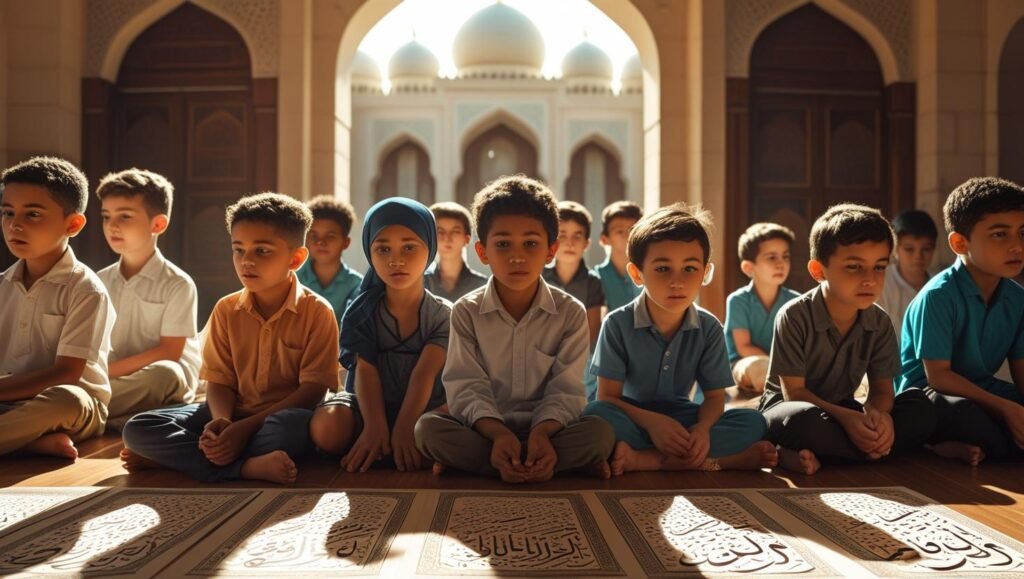
Reading and writing are the foundation of a child’s linguistic and intellectual development in Arabic. A child who masters them can understand texts, express ideas and communicate correctly and fluently. Through these skills the learner comes to know the letters and how they combine into words and sentences, and gains abilities that remain useful throughout every stage of education.
Why reading and writing matter
Reading and writing are complementary processes through which Arabic is understood and used naturally in daily life. Children who master both are better able to follow books and educational material at school and at home. Their reading, writing, comprehension and communication all improve, and they develop a love of learning and independence of thought.
Established methods for teaching reading and writing
Choosing a complete, structured programme is the first step towards success. Two approaches are widely used for this purpose.
The Noor Al-Bayan method
The Noor Al-Bayan method is known for bringing children quickly to correct reading with full vowel marks. It teaches the letters and their sounds gradually, then blends them so that the child reads words and then sentences, building the skill with confidence and fluency.
The Noorani Qaida
The Noorani Qaida concentrates on precise phonetic reading rules. It gives particular attention to the articulation points and characteristics of the letters, which makes sound reading easier for the child and later supports recitation of the Holy Quran and fluent pronunciation of standard Arabic.
Phonemic awareness: the key to reading
Any successful teaching plan teaches the child the sounds of the letters and not only their names. Once a child learns that the letter ب is pronounced “ba”, “bi” or “bu” according to its vowel, reading whole words becomes far easier and does not require laborious spelling. Phonemic awareness can be strengthened with simple activities, such as clapping once for every syllable in a word, or looking around the home for objects whose names begin with a given sound. Both activities develop attention and concentration.
Writing skills: from tracing to independent writing
Writing strengthens a child’s visual and motor memory. To build the skill soundly, it is best to proceed in stages:
- Teach each letter on its own, with attention to how it is drawn and where its dots are placed.
- Practise the forms the letter takes at the beginning, middle and end of a word.
- Move on to writing on the line, using practice books with clear ruling that help the child control spacing and improve handwriting.
Learning online: platforms and interactive lessons
Online learning has become an attractive and effective way to teach reading and writing, particularly for children growing up outside Arabic-speaking countries. Some platforms follow the child’s performance and adapt their recommendations accordingly. Educational games designed for children aged four to ten teach through play, so that the child does not feel the weight of study, and interactive video turns traditional lessons into enjoyable activities that encourage thinking. Families who would like structured lessons with a teacher can read the steps to register for remote lessons at Noor Elbayan Academy, where lessons are live, one-to-one and 30 minutes long.
Practical tips for parents
- Begin early, when the child’s capacity to absorb language is at its highest.
- Use correct standard Arabic during practice.
- Repeat exercises consistently, and do not move to a new level until the previous one has been mastered.
- Set aside a reading corner at home with attractive stories and picture books.
- Offer small rewards whenever progress is made.
- Make use of interactive educational programmes.

Conclusion
Teaching children Arabic is a genuine investment in their minds and their future. Sound reading rules, well-developed phonemic awareness and interactive resources together overcome most of the difficulties of learning the language, and a short daily routine of repetition is the most important factor of all. Parents of children who do not speak Arabic at home may also find the academy’s guide to teaching Arabic to non-native speakers useful.
Frequently asked questions
At what age should a child begin learning to read and write?
It is best to begin the basics of the letters from age 6, when the child’s linguistic and learning abilities are at a favourable stage.
Should teaching begin with letters or with words?
It is better to begin with the Arabic letters and their sounds, then move gradually to forming words and reading simple sentences.
How can learning be made enjoyable for the child?
Educational games, coloured flashcards, interactive activities and short stories make reading and writing an enjoyable experience and prevent boredom.
Is it better to teach standard Arabic or a spoken dialect?
Standard Arabic is the basis for teaching reading and writing because it is the language of books and curricula. Dialects are used only in everyday conversation.