 Noor Elbayan Academy
Teaching Children to Read Through the Verses of the Quran

Teaching children to read through the Quran and the Noor Al-Bayan method is an effective way to help them master Arabic correctly. By linking letters to Quranic words, the method develops reading and writing skills from an early age while nurturing love for the Quran and an understanding of its meanings. Children learn interactively, with attention to Tajweed and the vowel marks, which strengthens sound recitation and reflection on the verses.

Why children memorize the Quran
Memorizing the Quran is more than retaining text. It is a spiritual journey that connects the child to the words of Allah and opens the way to wisdom and values that guide a whole life. Quran memorization for a child can be compared to planting a seed in the heart: each letter and word is engraved like carving on stone, and over time the seed grows into a firmly rooted tree that bears good character in every situation.
The wisdom of memorization in the Quran and Sunnah
- A connection to divine light. The Quran lights the path through life, and its verses become an inner lamp for the child who memorizes them. Allah says: يَا أَيُّهَا النَّاسُ قَدْ جَاءَكُم بُرْهَانٌ مِّن رَّبِّكُمْ وَأَنزَلْنَا إِلَيْكُمْ نُورًا مُّبِينًا — “O mankind, there has come to you a conclusive proof from your Lord, and We have sent down to you a clear light” (Surah An-Nisa: 174).
- A balanced character. Memorization teaches discipline and concentration and instils honesty, patience and humility. The Prophet, peace and blessings be upon him, said: “I was only sent to perfect noble character.”
- Tranquillity. Children who memorize and regularly recite the Quran experience calm of heart. Allah says: الَّذِينَ آمَنُوا وَتَطْمَئِنُّ قُلُوبُهُم بِذِكْرِ اللَّهِ ۗ أَلَا بِذِكْرِ اللَّهِ تَطْمَئِنُّ الْقُلُوبُ — “Those who believe and whose hearts find rest in the remembrance of Allah. Truly, in the remembrance of Allah do hearts find rest” (Surah Ar-Ra’d: 28).
From spelling to recitation
In the Noor Al-Bayan method the child first understands letters and vowel marks, then moves gradually to reading and reciting verses. The process resembles building a house:
- The letters are the first bricks.
- The vowel marks are the doors and windows.
- Sound recitation is the interior finish that makes the house comfortable and beautiful.
Memorization of the Quran is the crown of that house. In this way children learn the Quran and also acquire the values and character that prepare them to benefit their communities.
The reward of the parents
The reward of parents who help their child memorize the Quran is great in this life and the next. Several hadiths describe it.
The crown of honour
The Prophet, peace and blessings be upon him, said: “Whoever recites the Quran, learns it and acts upon it, his parents will be given a crown to wear on the Day of Resurrection whose light is better than the light of the sun in the houses of this world. So what do you think of the one who acted upon it?” (narrated by Abu Dawud). Parents who helped their child memorize and live by the Quran are honoured for their part in that upbringing.
Raised ranks
The Prophet, peace and blessings be upon him, said: “It will be said to the companion of the Quran on the Day of Resurrection: recite and ascend, and recite as you used to recite in the world, for your station is at the last verse you recite” (narrated by al-Tirmidhi). As the child rises in rank through recitation, the parents share in the reward because they were a cause of that achievement.
Good that continues into the Hereafter
Teaching a child the Quran is a form of ongoing charity for the parents: whenever the child recites, in prayer or outside it, their reward continues. The Prophet, peace and blessings be upon him, said: “When the son of Adam dies, his deeds come to an end except for three: ongoing charity, knowledge that is benefited from, or a righteous child who prays for him” (narrated by Muslim). The Quran is among the greatest knowledge parents can pass on to their children.
The stages of the learning journey
The journey begins by introducing the alphabet in a simple way, moves to correct pronunciation with the vowel marks so that words and phrases can be read with ease, and then progresses to reading Quranic text with correct recitation and to memorization.

Foundation in the letters
The method introduces each Arabic letter visually and aurally so that the child recognises it at the beginning, middle and end of a word. This stage is the cornerstone of reading: the child learns to distinguish the letters, write them and pronounce them. Daily exercises make the progress gradual and enjoyable and prepare the child for the later stages.
Understanding the vowel marks
After the letters, the child learns the three basic vowel marks, fathah, dammah and kasrah, and how each changes the sound of a letter. Repeated pronunciation and listening exercises, followed by short words and sentences, strengthen reading and spelling and prepare the way for measured recitation of the Quran.
Sound recitation
This stage teaches the child to read the Quran correctly according to the rules of Tajweed. It concentrates on the articulation points of the letters and on rules such as madd, ghunnah, izhar and idgham. Repetition, continuous practice and individual guidance enable the child to pronounce each Quranic word accurately.
Memorizing the Quran
With letters, vowel marks and recitation in place, the child begins Hifz. Surahs and verses are divided into small portions suited to the child’s ability and revised regularly so that they remain firm. Repetition and listening and visual cues support memory, and encouragement gives the child a sense of achievement with every verse. Attention is also given to the meanings of the verses, so that the child reflects on what is memorized.
Reading and writing in the Noor Al-Bayan method
Teaching reading and writing with the Noor Al-Bayan method relies on a set of complementary practices:
- Gradual introduction of the letters: each letter is learned by shape and sound, which makes reading words easier later.
- Teaching aids: flashcards and interactive games make learning more enjoyable and motivating.
- Repetition and practice: reading and writing words repeatedly builds confidence and retention.
- Vowel marks: understanding fathah, dammah and kasrah improves pronunciation and reading accuracy.
- Correct recitation: reciting the Quran properly strengthens reading and basic phonetic skills.
- Quranic stories: stories carry valuable lessons and develop reading comprehension.
- Practical application: children use their skills in simple tasks such as writing a short message or reading an easy text.
- Assessment and feedback: progress is checked regularly and positive feedback helps the child improve.
Innovative teaching principles
- Gradual progression: from simple letters and vowel marks to recitation and memorization, step by step.
- Repetition and reinforcement: verses are repeated consistently to secure memorization and recitation.
- Listening and visual engagement: illustrated stories, nasheeds and coloured cards hold attention and clarify the vowel marks and recitation rules.
- Practice: the child applies what is learned by reciting, which improves performance.
- Encouragement and reward: positive reinforcement for progress sustains the love of learning.
- Reflection: the child is encouraged to understand the simple meanings of what is memorized and its relevance to daily life.
Developing moral values
Moral values are a foundation of the child’s character, and teaching the Quran is an effective way to develop them:
- Selected verses: children learn verses on honesty, trustworthiness and respect, absorb their meanings through repetition and begin to apply them.
- Stories of the Prophets: the example of the Prophet Muhammad, peace and blessings be upon him, in honesty and trustworthiness helps children understand why these values matter.
- Interactive activities: short role plays of Quranic stories that highlight good conduct make the values easier to grasp.
- Guidance at home: parents apply Quranic values in the household and discuss good behaviour with their children.
- Daily practice: values such as generosity are reinforced through everyday acts, for example helping others.
- Encouragement: a good deed is acknowledged with words of praise or a small gift.
- Reflection: children are taught to consider the deeper meanings of verses and how to act on them.
Learning through play
Play is a natural and well-liked way for children to learn and explore. It can support Quran and reading lessons in several ways:
- Educational games: puzzles and board games strengthen understanding and recall.
- Interactive activities: chanting, acting and drama encourage active participation.
- Small projects: researching, planning and completing a simple project builds communication skills alongside new knowledge.
- Stories as play: acting out Quranic stories, or using puppets, makes moral lessons more appealing.
- Rewards: stickers or points collected towards a goal encourage participation.
- Playing with siblings and friends: this develops social skills and allows children to share what they know.
- The surrounding environment: a visit to a park or the use of natural materials supports learning through exploration and observation.
Play of this kind also develops critical thinking and creativity.
The role of the family
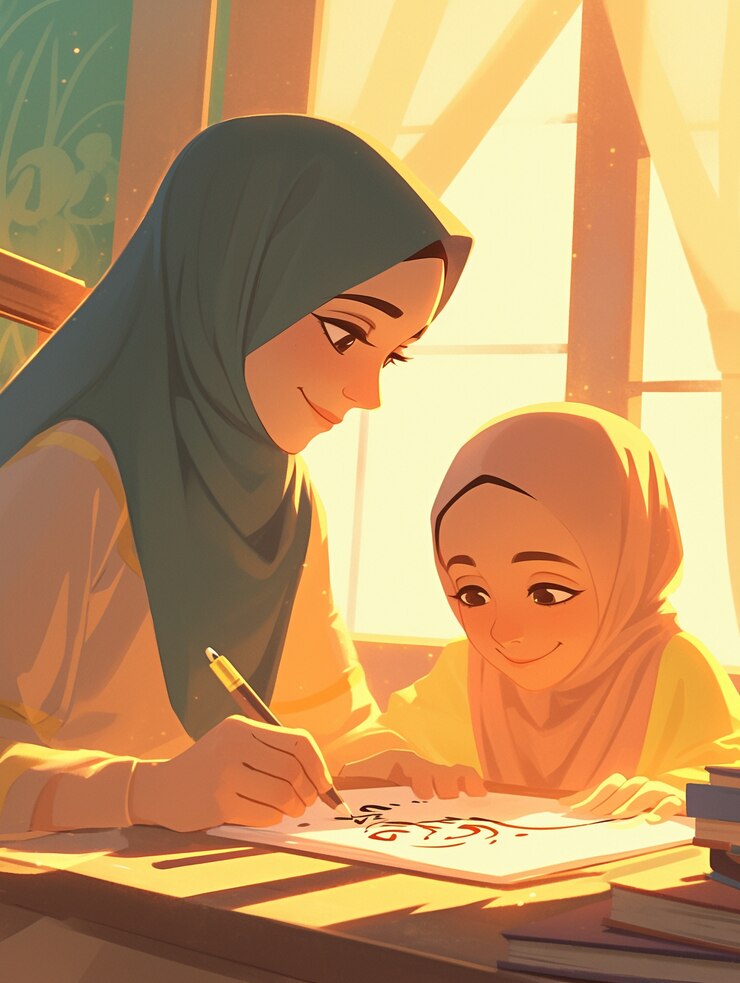
The family has a central role in a child’s education, particularly in reading, writing and memorizing the Quran. Its support extends beyond material provision to emotional and educational support.
- A positive learning environment: a quiet, well-equipped place helps the child concentrate and feel at ease.
- Participation: reading Quranic stories together and helping with memorization gives the child a positive view of learning.
- Emotional support: encouragement and recognition when goals are reached build self-confidence.
- Shared goals: a clear target, such as a set number of verses each week, creates responsibility and motivation.
- Monitoring and guidance: following progress and speaking with the teacher shows parents how best to help.
- Islamic values: linking lessons to daily life, for example by discussing how a Quranic value applies in an everyday situation.
- Learning resources: books, educational games and online programmes that support the Noor Al-Bayan method.
- Learning experiences: visits to the mosque help children understand Quranic teachings more deeply.
Cooperation between the family and the teacher makes the method more effective and gives the child a complete learning experience.
Why the method matters today
- It suits modern education: active, interactive learning helps children engage with the content.
- It builds core skills: reading and writing enable independent learning in every field.
- It strengthens moral and religious values: values drawn from the Quran shape good character and religious knowledge.
- It involves the family: cooperation between teachers and parents creates a supportive environment.
- It works with technology: educational applications and digital tools can enrich the experience.
- It encourages critical thinking: children develop problem-solving and decision-making skills.
- It prepares children for the future: Quranic education helps them build their Islamic identity and understand the world around them, and guides them towards sound principles when they face the challenges of the age.

Creative ways to help children memorize the Quran at home
The hero’s journey
Memorization can be presented as an adventure in which the child is a hero searching for treasure and each part of a verse is a treasure to be reached. Story and suspense hold the child’s attention.
Technology
Quran memorization applications designed for children offer interactive features such as audio games and rewards. Audio recordings of different recitations can also be played for the child to listen to.
Art and creativity
- Lettering: the child colours or draws the verses, or adds creative elements that express their meanings to a large display.
- A short play: performing a small piece that includes the memorized verses allows self-expression and understanding of the meanings.
Educational games
- Memory game: each card carries part of a verse and the child matches the parts.
- Treasure hunt: cards with verses are hidden in different places for the child to find and assemble.
Learning with others
- Friendly contests: a small memorization contest among siblings or friends, with simple prizes, encourages healthy competition.
- Teaching one another: children often understand more when they share what they have learned.
A comfortable setting
A dedicated corner of the home for the Quran, in calm colours and supplied with books and learning materials, helps the child feel settled and focused.
Stories through time
Memorization can be linked to the stories of the Prophets or the events connected with the verses: the story is told first, and the child then memorizes the verse that relates it.
Learning with Noor Elbayan Academy
Noor Elbayan Academy teaches reading, Tajweed and Hifz through live one-to-one lessons of 30 minutes with certified Azhari teachers, with a report after every lesson and a free trial lesson. Parents may contact the academy with any questions about its courses.