 Noor Elbayan Academy
Teaching Your Child to Read and Write Arabic with Ease
Early education shapes a child’s character and abilities. The pre-school years are among the most important, because this is when the foundations of learning are laid and a child needs steady support. Learning the mother tongue is a central part of that journey, and it becomes easier when lessons include educational games, engaging pictures and interactive activities that build vocabulary and hold a child’s attention.
Reading and writing are among the most important skills a child needs in order to grow. With the Noor Al-Bayan method, the process becomes simple: the child learns to read letters and words step by step, then moves on to short stories and the meanings of words. Parents can strengthen a love of reading at home by making it part of daily life. With a little guidance, the child learns to read and to recite with Tajweed naturally, and books become a normal part of the day. Learning at this age should be an enjoyable experience that builds a lifelong habit, not merely a daily task.

Benefits of teaching a child to read and write
Stronger language skills
Reading and writing develop a child’s vocabulary and ability to communicate clearly. The main gains are:
- A wider vocabulary: children acquire new words and express their thoughts and feelings more precisely.
- Better reading comprehension: regular reading teaches children to understand and interpret texts.
- Better listening: listening to stories and texts trains attention and the understanding of spoken information.
- Effective communication: children interact more easily at school, at home and in the community.
- Easier learning in other subjects: science and mathematics also depend on reading texts and exercises well.
- Creative writing: children learn to express themselves through stories, poems and short essays.
- Awareness of other cultures: literary and historical texts introduce children to different ideas and broaden their outlook.
Critical thinking
Learning develops a child’s ability to analyse and understand information. This includes:
- Analysing information: children learn to evaluate ideas, check sources and understand context instead of accepting everything they hear.
- Solving problems: they become better at identifying problems and finding effective ways to solve them.
- Understanding different views: they learn to hold a discussion and respect opinions that differ from their own.
- Making decisions: they learn to base decisions on a careful look at the facts.
- Creativity and curiosity: they are encouraged to ask questions, explore topics in depth and develop new ideas.
- Applying knowledge: they learn to use what they know in real situations, which makes learning more effective.
Character and wider development
- Values and manners: learning the Quran carries values that shape a child’s character, such as honesty, cooperation and respect.
- Creativity: Quranic stories and interactive activities encourage imaginative thinking.
- Focus and discipline: learning requires attention, which builds organisation and self-discipline.
- Self-confidence: progress in reading and writing gives a child the confidence to join discussions and face new challenges.
- Wider horizons: learning feeds a child’s curiosity about the world and the wish to discover more.
- Independent learning: children who learn how to learn become more independent and responsible.
- Social skills: shared learning activities teach cooperation and teamwork.
- Academic success: a firm foundation in reading and writing supports achievement across school subjects.
How to teach reading and writing with the Quran and the Noor Al-Bayan method
Parents can follow the steps below, or contact Noor Elbayan Academy for guidance.
1. Start with the basics
Begin with the alphabet and its sounds using the Noor Al-Bayan method, which helps children connect each letter to its sound in an enjoyable way.
- Teach the alphabet: introduce the Arabic letters with coloured cards or educational songs.
- Connect sounds to letters: teach how each letter is pronounced, and use Noor Al-Bayan examples that show how letters join to form words.
- Teach the short vowels: explain fathah, dammah and kasrah and how they change the sound of a letter.
- Read simple words: move on to simple words from the Quran, such as the names of Allah or words that appear often in the verses.
- Repeat and practise: encourage reading aloud and writing letters and words so that the knowledge settles in memory.
2. Repeat Quranic verses
Reading short Surahs and verses with a child and asking the child to repeat them strengthens recognition of words and their sounds.
- Daily repetition: set aside time each day for short verses that are easy to memorise.
- Listening and imitation: play recorded recitations and let the child imitate the pronunciation.
- Flashcards: write verses on cards for the child to read aloud, with a simple meaning or translation added.
- Interactive games: play a “missing word” game in which the parent reads part of a verse and the child completes it.
- Linking verses to meanings: after memorisation, explain what the verses mean and why they matter. This deepens understanding and motivates further reading.
3. Writing activities
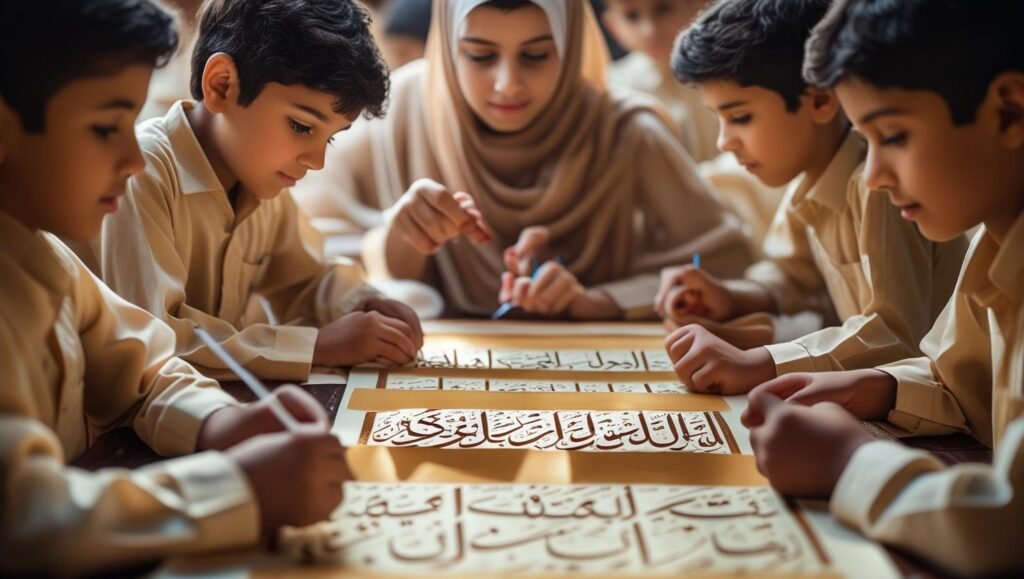
Use paper and pencil to teach Quranic letters and words, starting with easy letters and moving on to words from the verses.
- Writing verses: copying verses the child has learned improves handwriting and reinforces Hifz.
- Taking notes: the child writes short sentences or points about the values and lessons learned from the Quran.
- Writing stories: the child writes a story inspired by a verse or a religious event.
- Creative writing: colours, decoration, drawing and colouring verses make writing enjoyable.
- Educational apps: writing apps let the child practise letters and words interactively.
- Writing groups: group writing sessions with other children allow them to share ideas and learn to cooperate.

4. Integrated learning
Noor Al-Bayan materials that combine reading and writing, such as educational stories and exercises, help a child connect what is learned. Useful approaches include:
- Read and discuss: after reading a verse, discuss its meaning and lessons and ask the child how it applies to daily life.
- Read aloud: reading verses aloud improves pronunciation.
- Write and express: the child writes thoughts and feelings about the verses read, as a poem, a story or a short essay.
- Listen and respond: after listening to a recitation, the child writes what was understood or summarises the main ideas.
- Art activities: the child draws a scene from a Quranic story or writes a verse and decorates it.
- Visual aids: coloured cards and pictures linked to the verses make meanings easier to grasp.
- Vocabulary building: teach new words from the verses and ask the child to use them in sentences.
- Group projects: children prepare a presentation or posters on a theme or value drawn from the verses.
- Family involvement: read the Quran together, discuss the verses, and create a family book of stories and lessons that the children help to write and decorate.
5. Teaching values
Teaching values through the Quran is an essential part of upbringing:
- Good manners: use verses on honesty, trustworthiness and respect and show how these apply every day.
- Stories of the prophets: discuss the values they teach, such as patience, faith and generosity.
- Working together: encourage activities that reflect cooperation and sharing, such as community service or volunteering.
- Dialogue: ask questions and discuss how Quranic values apply in particular situations.
- Mercy and justice: verses on mercy and justice teach the importance of giving to others and helping them.
- Daily practice: make these values part of the routine: helping others, respecting elders and treating friends kindly.
6. Repetition and revision
Daily revision of letters and Quranic words strengthens memory.
- Repeat verses regularly: periodic repetition helps the child absorb the text.
- Revise lessons: vary the method with games and interactive activities so that revision stays enjoyable.
- Train the ear: listening to different recitations reinforces correct pronunciation.
- Revision cards: prepare cards with Quranic words or verses.
- Learn from mistakes: treat reading and writing errors as an opportunity to repeat and correct.
- Scheduled sessions: hold a regular revision session, for example once a week, to return to earlier material.
7. Educational games
- Card games: the child reads a word or verse on a card, then gives its meaning or uses it in a sentence.
- Word search: the child looks for a list of Quranic words in a text.
- Matching games: the child matches a word to its meaning or picture.
- Interactive stories: the child reads parts of a story containing verses and answers questions about it.
- Role play: the child acts out a story or situation from the Quran.
- Puzzles: jigsaws and riddles built on Quranic words or new vocabulary.
- Reading competitions: friendly contests with simple prizes such as certificates or small rewards.
8. Encouragement and support
Positive support builds a child’s confidence and willingness to continue.
- Praise effort: acknowledge every step forward, however small.
- Create a stimulating space: make the study area comfortable and attractive, with bright colours and cheerful learning aids.
- Take part: read with the child and help with writing. This strengthens family bonds and motivation.
- Set short-term goals: small, achievable goals give a sense of accomplishment.
- Offer emotional support: when the child is frustrated, explain that learning takes time and effort.
- Provide extra resources: educational books, videos and apps.
- Use rewards: a simple reward system for reaching specific goals.
9. Using technology
- Educational apps: reading and writing apps with Quranic content, interactive activities and games.
- Audio recitations: online recitations improve listening and pronunciation.
- Educational videos: videos that explain the basics of reading and writing in an engaging style.
- E-books: Quranic texts the child can read on a tablet or phone.
- Interactive websites: quizzes and language games.
- Online study groups: the child shares knowledge with peers learning the Quran and Arabic.
- Parent communities: forums and social media groups where parents exchange resources and ideas.
- Digital projects: slide shows or educational games on Quranic themes.
Followed consistently, these steps help a child acquire reading and writing skills in an effective and enjoyable way and deepen the child’s connection to the Quran.