 Noor Elbayan Academy
Teaching Arabic to Non-Native Speakers: A Practical Guide
Learning Arabic is more than acquiring a new language: it gives access to a rich literature and a long history, and for many learners it is the means of reading the Quran in the language in which it was revealed. This guide sets out what effective Arabic teaching for non-native speakers involves, from the first sounds to a complete programme, for beginners and advanced learners alike.
What teaching Arabic to non-native speakers means
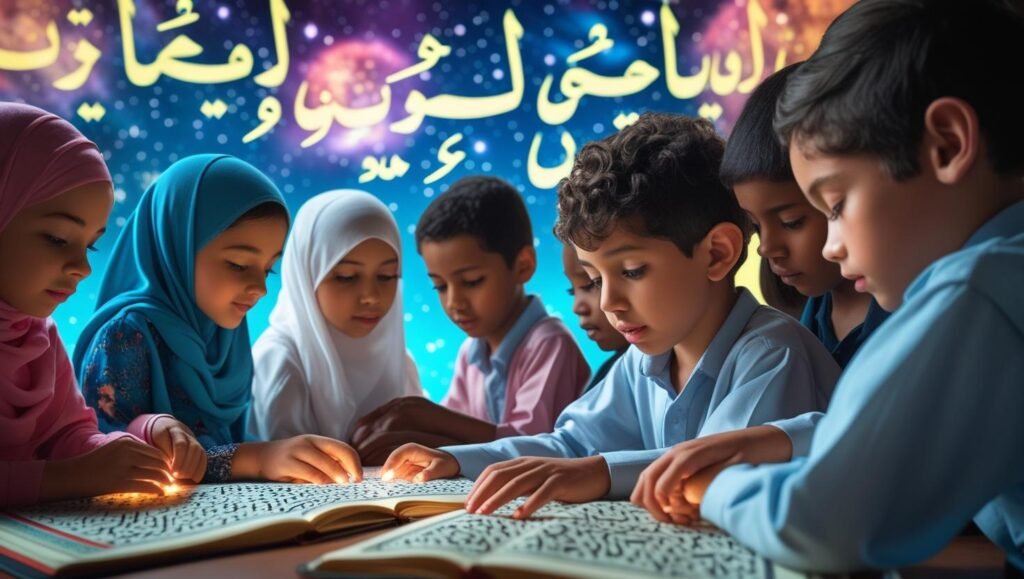
Teaching Arabic to non-native speakers means conveying the core skills of the language, not only theoretical information. The aim is for the learner to use Arabic in practice: reading, writing, listening and speaking. That requires a precise understanding of how the language works, in its sounds, its word structure and its sentence patterns.
Arabic is not taught in exactly the same way as other languages, because its sound system and its morphology are distinctive. This is why a structured programme within a specialised centre or academy is so important if the language is to be learned correctly.
The best approach to teaching Arabic
Letter sounds: the foundation
Every learner’s first challenge is the sounds of the letters. Arabic has letters that do not exist in most other languages, and teaching the correct articulation points is what distinguishes one programme from another.
- Building the sounds first: a good academy provides high-quality recordings so learners can imitate correct pronunciation.
- A clear learning sequence: follow a graded plan that starts with the simple and progresses to the complex.
The role of academic institutions
Academic institutions play a central part in developing teaching curricula. Specialised programmes for non-native speakers, supervised by qualified specialists in Arabic and Islamic studies, give students sound, well-researched content within a structured academic framework.
Arabic between tradition and modern life
Language cannot be separated from literature. To become truly fluent, a student needs to appreciate the beauty of poetry and become familiar with the character of Arabic literature. Modern audio and video content has also made Arabic more accessible to young people and learners.
- Arabic literature: reading metrical poems strengthens the learner’s sense of the rhythm of the language.
- The spirit of the culture: teaching Arabic also means conveying Arab culture and values.
Short videos and quick learning
Learning is no longer confined to the textbook. Short-video platforms have become an active space for learning Arabic through brief, direct lessons.
- Searching for Arabic-learning hashtags brings up short videos that explain grammar simply.
- Likes and comments encourage teachers to keep producing free content.
- Short videos help non-native learners overcome their apprehension about the language.

What a complete programme should include
Any programme designed for non-native speakers should provide:
- Enough hours for practice and application.
- A variety of learning tools: books, recordings and apps.
- A link to the Quran, so learners understand both the spiritual and the linguistic context.
- Capable teachers who can simplify information and convey it clearly.
Practical tips for teachers and centres
Centres that teach Arabic to non-native speakers should focus on three things:
- Quality of content: ensure that every lesson carries real value for the learner.
- Engagement: encourage students to ask questions and take part.
- Cultural variety: alongside Modern Standard Arabic, introduce aspects of everyday Arab life.
Conclusion
Teaching Arabic to non-native speakers is a responsibility and a worthy mission. A complete programme that brings together the literature of the past and the tools of the present can produce confident, creative learners. Learning Arabic is an introduction to the beauty of the language in which the Quran was revealed.