 Noor Elbayan Academy
Teaching the Quran to Young Children: A Guide for Parents
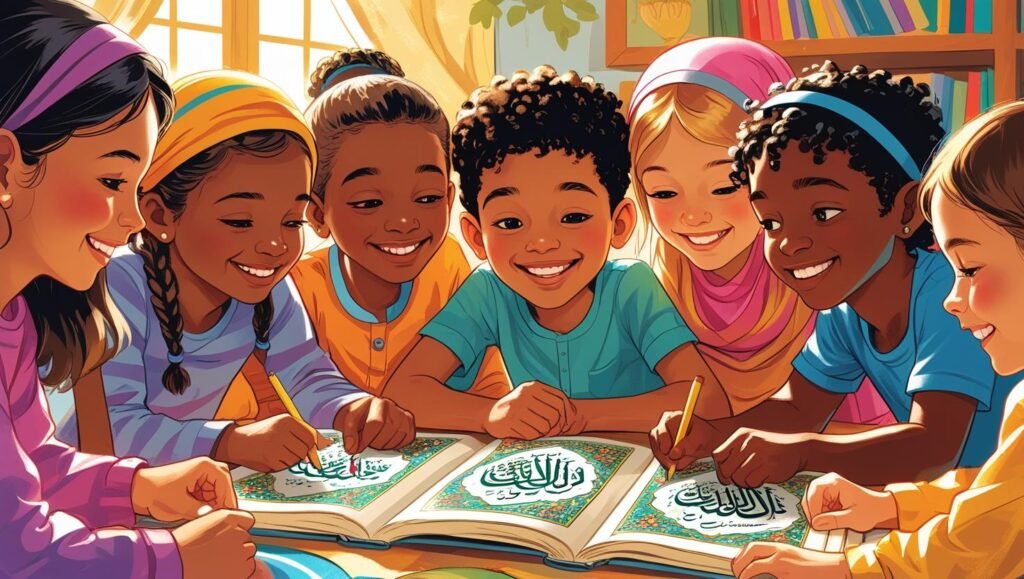
Teaching the Quran to children at an early age is one of the most valuable foundations a family can provide. It shapes character, strengthens faith and develops abilities that benefit a child well beyond the Quran lesson. This guide sets out the benefits of an early start, practical methods that keep children engaged, the role of the family, the challenges parents commonly face and the qualities to look for in a teacher.
Why teach children the Quran at an early age
- Islamic values and good character. The Quran establishes a firm moral framework that includes honesty, trustworthiness, respect for others and mercy.
- Memory and mental ability. Memorizing verses strengthens concentration, retention and recall, which also supports achievement at school.
- A stronger connection to the faith. Children who learn the Quran early understand their religion better and develop a close spiritual relationship with Allah.
- The habit of obedience and remembrance. Regular recitation accustoms children to remembering Allah and nurtures a love of worship.
- Protection from negative influences. Quranic values help children to face the challenges of life with wisdom.
- Stronger Arabic. The Quran is the highest source of the Arabic language, and learning it improves a child’s linguistic and expressive skills.
Early Quran education is therefore a long-term investment in a generation that is balanced in both character and knowledge.
Engaging methods for helping children memorize the Quran
Stories
Present the stories of the Prophets found in the Quran, such as those of Yusuf, Musa and Nuh (peace be upon them), in a way suited to the child’s age, and connect each story to the verses being learned. Children can also draw scenes inspired by these stories or act them out.
Play and interactive activities
Games built on repeating verses, puzzles that require arranging verses in order and activities that match a verse to its meaning make memorization enjoyable. Colouring books with short verses and their meanings serve the same purpose for younger children.
Visual and sensory learning
Coloured flashcards that show a verse with its meaning and a brief explanation, together with illustrated educational videos, help children who learn best by seeing.
Listening and repetition
Play a clear, beautiful recitation regularly, and repeat the verses with the child in a measured and pleasant rhythm. Recording the child’s own recitation and playing it back gives a real sense of accomplishment.
Rewards and recognition
Offer a simple reward or a decorated certificate of appreciation listing the Surahs memorized, and use sincere words of praise whenever a Surah or portion is completed.
Gradual progress
Begin with the short Surahs, explain their meanings, and advance step by step. Divide each Surah into small sections and link each section to an activity.
The role of the family in nurturing a love of the Quran
- Setting an example. A child who sees parents reciting the Quran regularly and living by its teachings absorbs love for it without feeling compelled.
- A daily time for the Quran. Choose a calm, fixed time for the family to recite together, such as after the Maghrib prayer or before sleep.
- A home familiar with the Quran. Play recitation in the home, particularly in the morning, and tell Quranic stories in a simple and engaging way.
- Simple explanation. Explain the verses at the child’s level and relate them to everyday situations.
- Family recitation sessions. Let each member of the family recite what he or she has memorized, take turns reading and discussing meanings, and praise the child in front of the others.
- Learning combined with enjoyment. Use educational applications and hold friendly family contests in memorization or recitation.
- Quran programmes. Enrol the child in a Quran memorization programme and encourage participation in memorization contests where these are available locally.
- A personal Mushaf. Give the child a Mushaf of a suitable size and attractive design, and teach the child how to care for it and treat it with respect.
- Supplication. Pray often that Allah makes the Quran the delight of the child’s heart, and include the child in that supplication.
- Patience. Proceed gradually and without pressure so that the child’s attachment to the Quran lasts for life.
Challenges in teaching the Quran to children and how to overcome them
| Challenge | Solution |
|---|---|
| Limited concentration; children are naturally active | Keep sessions short, around ten to fifteen minutes, and use engaging methods such as educational games and interactive repetition. |
| Boredom and loss of enthusiasm caused by routine | Vary the approach by combining recitation with stories and activities, and hold friendly contests at home. |
| Not understanding the verses | Simplify the meanings with examples and stories from the child’s own world, supported by flashcards or illustrations. |
| Weak family involvement | Hold short daily sessions in which the family takes part and sets a positive example. |
| Teachers who lack the skills to teach children | Choose teachers who specialize in teaching children and who use sound educational methods. |
| Memorization without understanding | Combine memorization with simple explanation, and link the text to real situations. |
| Little use of technology | Use interactive Quran applications and play good recitations on smart devices. |
| Differences in ability between children | Adapt the pace and method to each child’s learning style, whether visual, auditory or kinaesthetic, and give additional time to those who need it. |
| Limited time because of school commitments | Fix a regular time, even a brief one, and make the Quran part of the daily routine, for example before sleep. |
| Impatience from parents or teachers | Progress gradually, allow sufficient time for memorization and understanding, and commend every effort, however small. |
How learning the Quran shapes a child’s behaviour and values
- Good character. Honesty, trustworthiness, mercy, forgiveness, respect for others and self-discipline.
- Responsibility. Verses on justice and excellence encourage a child to take duties towards self, family and community seriously.
- Faith and tranquillity. Recitation brings calm, and verses on the greatness of Allah strengthen trust in Him.
- Patience and perseverance. Memorization itself requires persistence, and the stories of the Prophets inspire patience in difficulty.
- Stronger relationships. The Quran teaches respect for parents, the maintenance of family ties, cooperation and helping others.
- Protection from harmful behaviour. Quranic values guard a child against lying, bullying and violence, and encourage wise conduct.
- Love of learning. The Quran urges reflection and the pursuit of knowledge, and develops skills in classical Arabic.
- Confidence and independence. Reciting before others builds self-confidence, and clear values support sound decisions.
- Generosity. Verses on charity encourage giving and compassion for those in need.
- A balanced personality. The child learns to distinguish right from wrong and to combine ambition with moral commitment.
How modern technology supports Quran learning
- Quran applications that offer recitation, verse repetition with correct pronunciation and educational games.
- Interactive videos that use animation to explain meanings and Quranic stories and demonstrate Tajweed rules with practical examples.
- Educational games such as puzzles for ordering verses and listening exercises.
- Electronic recitation devices such as reading pens that play a verse when passed over the text and colourful tablets that pronounce each word.
- Live online lessons with specialist teachers through platforms such as Zoom or Google Meet.
- Artificial intelligence tools that assess a child’s pronunciation and give simplified explanations suited to the child’s level.
- Virtual and augmented reality that present illustrations or explanations connected to the verses.
- Children’s educational programmes that teach Tajweed and present illustrated Quranic stories with recitation and explanation.
Used well, technology makes learning more engaging, makes material available at any time and place, can be adapted to each child’s ability, and allows repetition without boredom. It supports the teacher and the family and does not replace them.
Why the choice of teacher matters
The teacher is a decisive factor in whether a child learns effectively and forms a positive relationship with the Quran. A teacher of young children is also a role model who influences character and behaviour. A good teacher:
- recites correctly according to the rules of Tajweed and ensures accurate memorization through guided repetition;
- makes learning enjoyable through stories and age-appropriate challenges, so that the child comes to love the Quran;
- models good manners and uses everyday situations to reinforce Quranic values;
- recognizes individual differences and adapts the method to each child;
- builds trust and motivates the child without resorting to reprimand;
- progresses gradually and accepts mistakes with patience;
- communicates regularly with parents about the child’s progress and encourages follow-up at home;
- aims for understanding and application, not memorization alone.
Qualities of an excellent Quran teacher for children
- Mastery of Quran recitation and the rules of Tajweed.
- Patience and the ability to treat children with kindness and gentleness.
- Educational and psychological skills for dealing with children constructively.
- Flexibility and creativity in presenting the material.
Learning with Noor Elbayan Academy
Noor Elbayan Academy teaches children through live one-to-one lessons of 30 minutes over Zoom or Google Meet, with certified Azhari teachers who have more than ten years of experience. Lessons are available in English, French and Arabic, and include the Arabic alphabet and the correct articulation of letters for beginners. Parents receive a report after every lesson. Boys and girls are taught in separate classes, with female teachers for girls. A free trial lesson is available, and plans start from $40 per month.
Conclusion
Teaching the Quran to young children produces more than the ability to recite and memorize. With a supportive home, patient and varied methods and a capable teacher, it raises children of sound character who carry the Quran as a guide for life.