 Noor Elbayan Academy
The Seven Stages of Teaching Children the Quran Online

Noor Elbayan Academy gives children the opportunity to learn the Holy Quran from home. They memorize the Quran and learn the rules of Tajweed in live, interactive lessons with qualified and experienced teachers, at times that fit the family’s daily schedule. The aim throughout is to build a strong relationship between the child and the Quran.
Online Quran teaching has become an effective and important means of learning. Students in any country can reach a suitable teacher and study in a safe environment, and communication with the teacher is direct. The process passes through several stages that establish memorization and understanding gradually. These stages build on the Noor Al-Bayan method and its role in developing reading and Tajweed skills.
Stage 1: Foundation in letters and articulation
The foundation stage teaches the child the Arabic letters correctly and where each is produced in the mouth and throat. It focuses on:
- The Arabic alphabet: the child learns the letters separately, then their shapes at the beginning, middle and end of a word.
- The short vowels (fathah, dammah, kasrah): once the letters are mastered, the child learns to pronounce them with the three vowels in order to read words correctly.
- Articulation points: great care is given to producing each sound properly, for example the letters that come from the throat (such as ع and ح) and those that come from the tongue (such as س and ز).
- Listening to examples from the Quran: the child listens to verses recited accurately in order to refine pronunciation.
This stage is essential, because every later stage is built on correct pronunciation of the letters and words of the Quran. Arabic is taught alongside the Quran: children connect Arabic words with their meanings, which makes the verses easier to understand, and lessons are matched to each child’s age and level.
Stage 2: Tajweed and recitation
After mastering the letters and their articulation, the child begins to learn the rules of Tajweed and to recite the Quran according to them. Related techniques are described in the article on strategies for teaching children the Quran.
- Basic Tajweed rules: the rules of Noon Sakinah and Tanween (Izhar, Idgham, Iqlab and Ikhfa); the rules of Meem Sakinah (Izhar Shafawi, Idgham Shafawi and Ikhfa Shafawi); natural and secondary Madd; and Qalqalah, the echoing pronunciation of the letters ق ط ب ج د when they carry a sukoon.
- Practical application: the child reads verses while observing the rules and repeats them until they are mastered. The teacher guides the child and corrects mistakes continuously.
- Model recitation: the child listens to the teacher or to a skilled reciter, which trains the ear and shows how the rules are applied.
- Reading with Tarteel: the child learns to recite calmly and attentively, balancing accuracy with understanding.
- Gradual progress: recitation begins with short verses and Surahs and moves on to longer ones.
- Follow-up and assessment: the teacher assesses progress regularly and encourages the child to improve.

The goal of this stage is to instil a love of correct recitation, so that the child can read the Quran with Tajweed and is better prepared to understand its meanings.
A central purpose of the academy is to help children preserve their faith and identity. Male and female teachers with long experience teach every level online, and families anywhere in the world can register a child easily through the academy’s website or by WhatsApp.
Stage 3: Gradual memorization
In this stage the child begins to memorize verses and Surahs in an organised, planned way that takes account of individual ability.
- Dividing Surahs and verses: long Surahs are divided into short passages. Memorization usually starts with the short Surahs of Juz Amma, such as al-Fatihah, an-Nas, al-Falaq and al-Ikhlas, and then moves to longer ones. The number of verses is matched to the child’s ability and increased over time.
- Continuous repetition: the child repeats the verses several times a day, with the teacher or along with an audio recitation, until they can be recited without looking at the text.
- Memorizing aloud: pronouncing and hearing the verses strengthens retention, and the child attends to the words and the Tajweed rules at the same time.
- Daily revision: what has been memorized is revised every day, at a set time alongside the new verses, so that it settles in long-term memory.
- Listening to memorized verses: hearing the verses from accomplished reciters helps the child keep the recitation accurate.
- Gradual increase: the daily portion grows as the child advances, without overburdening the child.
- Encouragement: praise and small rewards give a sense of achievement and a reason to continue.
The aim is to form a daily habit of memorization that respects the child’s capacity, so that the Quran is memorized soundly, one step at a time.

Stage 4: Regular revision
Regular revision fixes memorized verses in the child’s mind and prevents them from being forgotten.
- A daily time for revision: revision is a fixed part of the daily schedule, shorter or longer according to the amount to be covered.
- Revision by Juz or Surah: for example, Juz Amma is revised over a week, or one complete Surah each day. As memorization grows, revision is spread across several parts, and the earliest portions are still revisited periodically.
- Repetition: the child recites the memorized portions several times, with the teacher, with a parent or along with an audio recitation.
- Spot checks: the teacher may ask about verses chosen at random from memorized Surahs.
- Varied methods: reciting from memory to the teacher or a parent, writing verses from memory, and listening to an accurate recitation and following it.
- Attention to difficult passages: extra time is given to verses the child finds hard or whose Tajweed rules are easily forgotten.
- Periodic assessment: regular tests reveal any weak points that need reinforcement.
Stage 5: Practical application before the teacher
The child recites what has been memorized to the teacher, so that the recitation and the application of Tajweed can be checked. This step is decisive in mastering the Quran.
- Regular recitation to the teacher: the child recites at each lesson while the teacher listens for errors in Tajweed or pronunciation.
- Immediate correction: mistakes are corrected at once, including rules such as Ghunnah, Idgham and Ikhfa and the articulation of the letters.
- Detailed guidance: the teacher advises on particular rules, on Tarteel, on breath control, on the lengthened letters and on stopping at the ends of verses.
- Harmony between memorization and recitation: the child learns to recite memorized verses fluently, which strengthens confidence.
- Listening to model recitations: the child is encouraged to listen to skilled reciters and imitate them.
- Recitation in prayer: reciting memorized verses in the daily prayers puts them to practical use.
- Assessment and motivation: the teacher gives feedback on performance and encourages improvement.
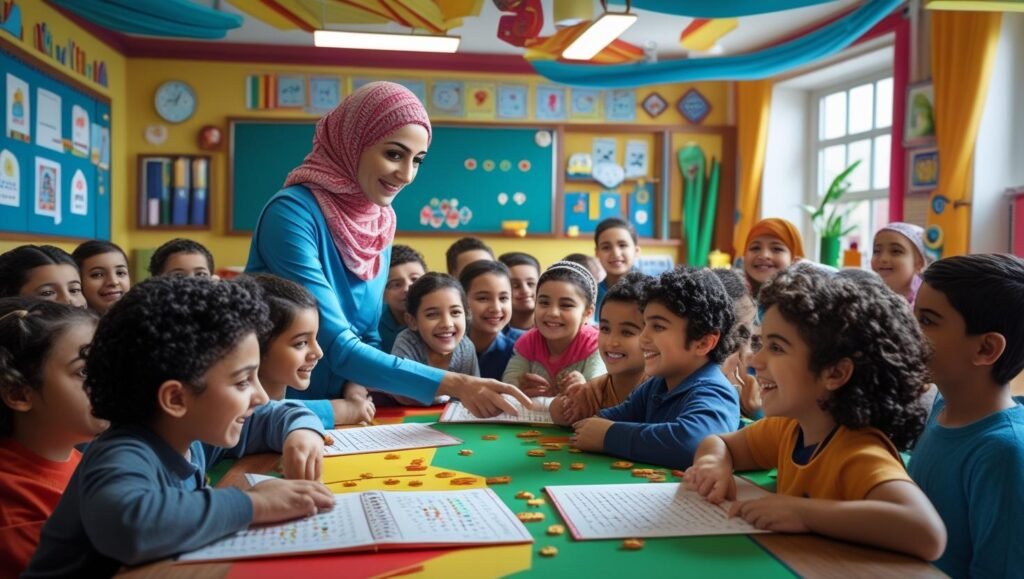
This stage turns memorization into sound recitation in practice and gives the child confidence to recite in front of others. The academy also offers Ijazah in the recitation of the Quran, which encourages children to engage and take part actively.
Stage 6: Testing and assessment
Assessment measures the child’s progress in memorization, recitation and Tajweed, and identifies the strengths and weaknesses that need attention.
- Periodic memorization tests: the child is tested, weekly or monthly, on recently memorized Surahs without looking at the Mushaf. The test may be oral or written from memory.
- Assessment of Tajweed and recitation: the teacher assesses pronunciation of the letters, lengthening, Izhar, Idgham and the other rules, and explains how to correct any errors.
- Testing earlier memorization: older Surahs are tested alongside new ones to ensure that they have been retained.
- Comprehensive tests: at advanced stages, a whole Juz or more is tested to measure readiness for the next level.
- Individual report: the teacher reports on the child’s performance, noting strengths and points for development such as mispronounced letters or forgotten verses.
- Feedback and motivation: constructive feedback follows every test, and parents may reward good results.
- Deciding on progression: the results show whether the child is ready to advance or needs further revision first.

Stage 7: Motivation and encouragement
Motivation keeps children memorizing and reciting with commitment, and strengthens their love for the Quran.
- Material and moral rewards: a gift or praise in front of the family after a Surah is completed reinforces the sense of achievement.
- Positive challenge: a friendly challenge at home, for instance between siblings, encourages greater effort.
- Verbal encouragement: phrases such as “well done” and “excellent” from teacher and parents give satisfaction and confidence.
- Parental involvement: parents follow progress and encourage the child at home. A small family celebration when a Juz is completed honours the achievement.
- Variety: some children prefer a material reward, others value recognition or a family outing. Variety keeps enthusiasm alive.
- Linking motivation to higher aims: the child is taught the importance of memorizing the Quran, the pleasure of Allah and the reward that awaits those who memorize it.
- Recognising effort: even small improvements deserve acknowledgement, because this builds a positive relationship with learning.
Enrolling at Noor Elbayan Academy
Noor Elbayan Academy offers live one-to-one lessons of 30 minutes over Zoom or Google Meet with certified Azhari teachers, with a report after every lesson. Parents with questions, or who wish to book a free trial lesson, can contact the academy at any time.