 Noor Elbayan Academy
Noor Al-Bayan Courses: Teaching Children Quran and Arabic
The Noor Al-Bayan method is one of the best-established approaches to teaching children to read Arabic and recite the Quran. Courses built on it give children a firm foundation in the Arabic language while developing their recitation and Tajweed, and they combine effective practice with understanding and reflection so that a child’s spiritual and cultural bond with the Quran grows alongside the skill of reading it.
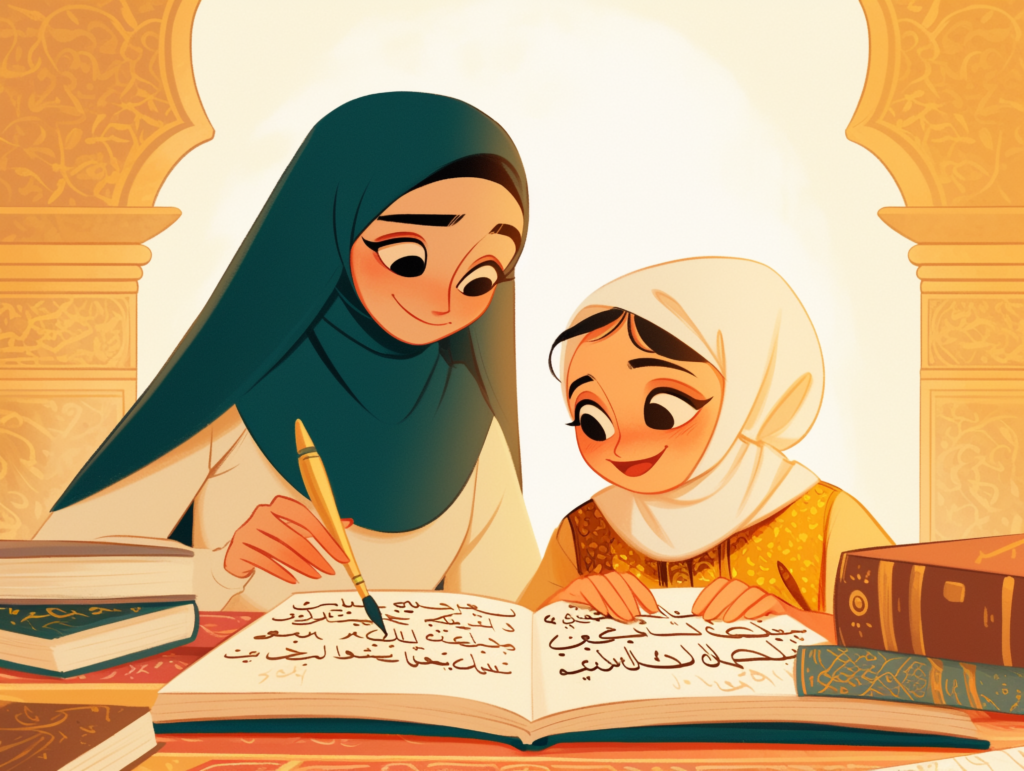
This guide explains why the Quran is the most valuable thing a child can learn, what Noor Al-Bayan courses contain, how they are taught and assessed, how they compare with other programmes, and how parents can support their children at home.
Why the Quran is the best thing to teach a child
Teaching the Quran benefits a child spiritually, intellectually and socially. The main reasons are as follows:
- Guidance: the Quran is a complete guide to life, with principles that help a child make sound decisions.
- Values and character: it instils honesty, trustworthiness and respect, which shape a child’s personality positively.
- Reading and recitation: learning to recite builds reading skills and strengthens Arabic in general.
- Understanding and reflection: reflecting on the meanings of the verses develops a child’s thinking and opens new horizons of understanding.
- Tranquillity: reciting the Quran brings calm and reassurance, which helps children face the challenges of life.
- Memory and concentration: Hifz exercises the memory and improves focus and comprehension.
- Social ties: Quran circles and community learning strengthen a child’s relationships.
- Spiritual reward: learning the Quran brings reward in this life and the next, and deepens a child’s sense of belonging to the Muslim community.
Teaching a child the Quran is therefore an investment in their spiritual, moral and intellectual future, and a foundation for a balanced character.
What Noor Al-Bayan courses cover
The course content is varied and integrated, and is designed to give children the knowledge and skills they need in both Arabic and Quran recitation.
The Arabic alphabet
- Recognising the Arabic letters and pronouncing them correctly.
- Practising how to write the letters and their vowel marks.
Words and vocabulary
- Building a rich vocabulary by learning new words in different contexts.
- Using pictures and games to support understanding.
Arabic grammar
- Learning the basic rules of Arabic, such as masculine and feminine forms, verbs and nouns.
- Practising the rules through interactive activities and short pieces of writing.
Tajweed rules
- Understanding the basic Tajweed rules that allow children to recite the Quran correctly.
- Applying those rules by reciting selected verses.
Reading the short Surahs
- Beginning with the short Surahs of the Quran, with attention to understanding and reflection.
- Using repetition to improve fluency.
Explanation and reflection
- Giving simplified explanations of the verses so that children grasp their meanings and lessons.
- Encouraging children to think about how to apply these values in daily life.
Practical training
- Providing regular opportunities to read and recite aloud.
- Assessing performance periodically to follow each child’s progress.
Teaching methods
Noor Al-Bayan courses rely on a range of teaching methods intended to make learning both enjoyable and effective.
Interactive teaching
Children are encouraged to take an active part in each lesson through questions, answers and discussion, in a supportive setting where they can express themselves freely and without fear. Encouragement and small rewards build their confidence.
Educational games
Games make new concepts easier to absorb. Examples that teachers and parents commonly use include:
- Crosswords and puzzles built from Quranic words or Arabic vocabulary.
- Flashcards showing letters or words, which the child is asked to identify.
- Reading a chain of words in sequence to strengthen reading and ordering skills.
- A “jump to the letter” game at home: letters are written on the floor and the child jumps to the correct letter when a word is called out.
Visual and audio aids
Animations, videos and pictures help to clarify concepts, and listening to recitations by accomplished reciters improves pronunciation and Tajweed.
Learning through practice
Children apply what they have learned by reading and reciting in front of the teacher, with regular drills to ensure that their skills improve.
Modern technology
Tablets and computers, together with interactive educational content, support flexible learning and independent practice. Through this combination of interactive methods and practical application, children are able to acquire language skills and Quran recitation in an accessible and inspiring way.
Practical training in recitation
Practical training is an essential part of the method, because it allows children to apply what they have learned.
- Individual reading: the child recites verses to the teacher, who assesses the recitation and gives immediate feedback.
- Applying Tajweed: practical exercises on the rules already studied, with a focus on correct pronunciation.
- Performance assessment: periodic tests of recitation and Tajweed, followed by constructive comments.
- Recording recitation: children may record their own recitation and listen to it afterwards, which improves pronunciation and self-confidence.
- Sharing understanding: children are invited to explain what they have read in their own words, which deepens their grasp of the text.
A focus on understanding
The curriculum places great weight on helping children to understand the Quran and the Arabic language, and not only to pronounce the words.
- Simplified explanation: verses and Surahs are explained in simple terms so that children can absorb their meanings and values.
- Questions and discussion: children are encouraged to ask about what they read, which develops critical thinking.
- Links to daily life: children are helped to connect Quranic values with their own experiences.
- Interactive activities: stories, games and small projects encourage children to think about meanings creatively.
- Reflection: children are encouraged to reflect on the verses and their purposes, which strengthens their spiritual connection with the text.
- Independent learning: children are guided to look up the meanings of words themselves, which builds independence and curiosity.
- Assessing understanding: assessment measures comprehension of meanings and concepts as well as performance.
Teacher preparation
The quality of any Noor Al-Bayan course depends on the preparation of its teachers. The most important aspects are:
- Specialised training in the Arabic language and the rules of Tajweed.
- Modern tools: the ability to use multimedia and educational technology to make lessons more engaging.
- Teaching methodology: a sound understanding of modern approaches such as interactive teaching and independent learning.
- Personal skills: strong communication skills that allow the teacher to build a positive relationship with each child.
- Self-assessment: regular review of their own teaching in order to identify strengths and weaknesses.
- Communication with parents: the ability to work in partnership with families to support the child’s learning.
- Continuous learning: a commitment to keeping up with developments in their field.
At Noor Elbayan Academy, lessons are taught by certified Azhari teachers with more than ten years of experience, and girls are taught by female teachers in separate classes.
Flexibility of study
Flexibility allows a course to meet the needs of children and parents comfortably and effectively.
- Flexible times: lesson times are arranged to suit the family’s schedule.
- Adaptable content: the material is adjusted to the level of each child so that every learner receives appropriate support.
- Varied media: printed materials, videos and digital resources allow children to learn in different ways.
- Distance learning: online lessons allow children to learn from anywhere.
- Continuous support and regular assessment: progress is measured periodically and teaching is adjusted where necessary.
Noor Elbayan Academy delivers the method through live one-to-one lessons of 30 minutes over Zoom or Google Meet, in English, French or Arabic. A lesson cancelled at least six hours in advance is replaced with a make-up lesson.
Continuous assessment
Continuous assessment measures a child’s progress and directs them towards improvement.
- Periodic assessments: short, regular tests identify each child’s strengths and weaknesses.
- Immediate feedback: comments given straight after a test or activity help children to understand and correct their mistakes quickly.
- Practical assessment: reading and recitation are assessed in practice to confirm that the child applies the rules correctly.
- Assessment of understanding: questions on the meaning of the verses check comprehension.
- Digital tools: short electronic quizzes can make assessment more interactive.
- Analysis of results: teachers use the results to adjust their teaching strategies.
- Encouragement: praise and rewards recognise children who make clear progress.
At Noor Elbayan Academy, parents receive a report after every lesson.
How the Noor Al-Bayan method benefits a child
- Arabic language: a firm foundation in reading, writing and communication.
- Recitation skills: the ability to read the Quran correctly.
- Tajweed: knowledge of the basic rules, leading to accurate pronunciation of letters and words.
- Understanding and reflection: a grasp of the meanings and lessons of the Quran, and a stronger spiritual connection with it.
- Self-confidence: improved reading and recitation give a child greater confidence in their abilities.
- An interactive learning environment: engaging methods that encourage participation.
- Values and character: Islamic values and good manners, learned through the meanings of the Quran.
- Independent learning: research and self-study skills that prepare a child for the future.
The growing demand for Islamic education
Demand for Islamic education continues to grow, for several reasons:
- Religious awareness: many Muslims wish to understand their religion more deeply.
- Technology: online learning makes it possible to enrol in a course from anywhere in the world.
- The family: parents are keen to teach their children Islamic values and the Quran.
- Community life: lessons and activities in mosques and Islamic centres encourage people to learn.
- Cultural identity: families seek ways to strengthen their children’s Islamic identity.
- Contemporary challenges: many people look for an Islamic perspective on the issues they face today.
How Quran courses improve recitation
- Tajweed instruction that leads to correct pronunciation and delivery.
- Constant practice in reading aloud, which builds confidence.
- Repetition and recitation from memory, which strengthen memory and fluency.
- Individual goals: a learning plan suited to the level of each student.
- Assessment and feedback that show students where they need to improve.
- Understanding: attention to the meanings of the verses, which deepens the student’s connection with the text.
Quran learning and school achievement
Quran education can also support a child’s wider academic progress in several ways:
- It reinforces good conduct and discipline, which carry over into other subjects.
- It encourages analysis and critical thinking.
- Memorising verses develops memory and attention.
- Students learn to manage their time effectively.
- It is a source of motivation and inspiration.
- Guidance from teachers helps students to set and reach their goals.
Teaching tools used in Noor Al-Bayan courses
- Books and printed materials: simply designed books covering the alphabet, Arabic grammar and Tajweed, with worksheets and written activities.
- Audio and visual aids: animations, educational videos and illustrated stories, together with audio recitations of the Quran.
- Educational games: paper or electronic games on Arabic letters and words, and puzzles that make learning enjoyable.
- Interactive screens and devices: lessons and activities presented on screen, with interactive content that children can practise with at any time.
- Flashcards: cards showing letters, Quranic vocabulary and pictures, which build quick recognition and a wider vocabulary.
- Recorded recitation: the child’s own recitation is recorded and reviewed with the teacher’s comments.
- Interactive assessment: short electronic quizzes that check the child’s level regularly.
Noor Al-Bayan courses compared with other Quran programmes
| Aspect | Noor Al-Bayan courses | Some other programmes |
|---|---|---|
| Curriculum | A comprehensive curriculum that teaches correct Quran reading together with simplified Tajweed from an early age. | May concentrate on reading or memorisation alone, without detailed attention to Tajweed. |
| Teaching aids | Books, flashcards, educational games, audio and visual aids, and modern technology. | Often rely on books alone or on applications alone, which can leave children bored or without personal interaction. |
| Assessment | Continuous assessment and personal follow-up, with immediate feedback on recitation. | May assess only at the end of the course, with general feedback that is not individual. |
| Activities | A variety of recitation practice, educational games and interactive activities. | May be limited to traditional memorisation and recitation, so children lose enthusiasm. |
| Focus on children | Content designed for young learners: simplified rules and visual and audio tools. | May address adults and children together and overlook children’s particular needs. |
| Cost and access | Generally affordable and available in learning centres or online. | Can be expensive, particularly where advanced technology or additional materials are required. |
In summary, the method is distinguished by combining theory and practice in an engaging way, by teaching Tajweed and correct reading from the first stages, by the variety of its teaching aids, and by continuous individual assessment.
Advice for parents
- Encourage constantly: praise the child when a verse is read correctly or progress is made in Hifz, and offer small rewards such as time for a favourite activity.
- Set a fixed daily time: choose a time when the child is mentally and physically ready to learn.
- Be a good example: a child who sees parents reading the Quran regularly will wish to imitate them.
- Be patient: learning takes time. Do not press for rapid progress; the aim is a strong and loving relationship between the child and the Quran.
- Prepare a suitable environment: provide a quiet, comfortable place to study, away from distractions, with aids such as Tajweed charts or colourful books.
- Use technology: educational videos and applications that are consistent with the Noor Al-Bayan method can make practice more enjoyable.
- Learn through play: flashcards and interactive activities create an enjoyable atmosphere at home.
- Work with the teacher: stay in contact with the child’s teacher to follow their level and to ask how to support them at home.
- Listen to the Quran together: at home or in the car, listening is a further source of inspiration and improves recitation.
- Repeat: make regular repetition of verses and Surahs part of the daily routine.
- Connect learning with daily life: relate the verses the child learns to everyday situations and stories.
- Encourage learning with peers: where possible, time spent with other children who are learning the Quran can motivate a child.
Conclusion
The Noor Al-Bayan method is among the most important approaches to Quran memorisation and Arabic teaching. It suits both native and non-native speakers of Arabic, children and adults, and combines instruction with practical exercise, covering the letters, vowel marks, elongations and the rules of Tajweed to ensure sound reading. Its suitability for online teaching has made it increasingly popular with families who wish to strengthen their children’s religious education.
Noor Elbayan Academy offers a free trial lesson and a 7-day money-back guarantee. Families who are interested in online Islamic education may contact the academy on WhatsApp.