 Noor Elbayan Academy
Teaching Arabic to Children: Reading and Writing Online
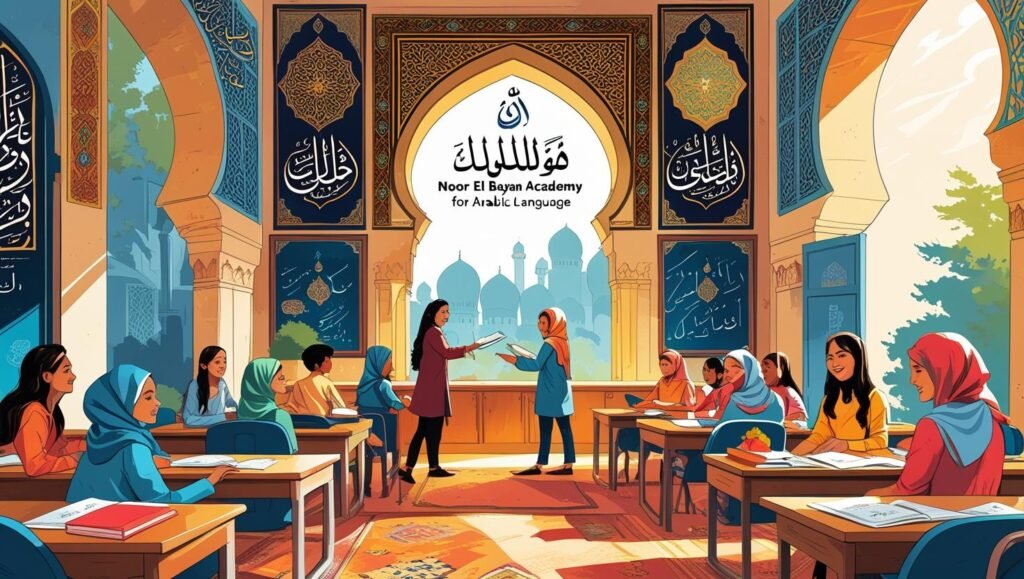

Arabic is central to the cultural and religious identity of Muslim families. Many parents want their children to read, write and speak the language well, yet find it difficult to locate specialist teachers or flexible programs at a reasonable cost. Noor Elbayan Academy teaches Arabic to children through live online lessons with specialist male and female teachers, and plans start from $40 per month.
Why families choose Noor Elbayan Academy for Arabic
The academy teaches the Quran and also teaches Arabic to children at every level, from the alphabet to fluent reading, writing and speaking.
Specialist, experienced teachers
The teachers are highly qualified in the Arabic language and its rules and have long experience of teaching children. They understand how young children learn and what motivates them, and they present difficult rules in a simple and enjoyable way so that the child understands the material and grows fond of the language.
A comprehensive, graded curriculum
The curriculum progresses step by step and covers the core language skills:
- Reading: taught through the Noorani Qaida or similar methods that focus on the correct articulation points of the letters and on sound spelling.
- Writing: children practise writing letters, words and sentences in clear, neat handwriting.
- Conversation: children are encouraged to speak Arabic in simple everyday situations and build their vocabulary gradually.
- Comprehension: stories and interactive activities strengthen understanding of written and spoken Arabic.
The curriculum is adapted to different ages and levels, from complete beginners to children who need to strengthen existing skills.
Flexible online learning
Lessons are held online, so a child can learn from anywhere in the world at a time that suits the family schedule. There is no travel, which saves time and effort, and the virtual classroom uses interactive tools that keep the lesson effective.
Affordable fees
The academy is committed to high-quality Arabic teaching at a cost that families can afford. Plans start from $40 per month, which allows a child to make steady progress without placing a heavy financial burden on the family.
Teaching children to read and write
Reading and writing are among the most important skills a child acquires in the early years. They are more than academic tools: they open the way to knowledge, shape character and broaden understanding. Good teaching is now easier to reach than before, whether in a traditional classroom or through online learning.
Why early reading and writing matter
- A strong foundation for learning: reading opens every school subject to the child, and writing allows the child to express ideas and organize information.
- Language and cognitive development: learning to read and write develops phonological awareness, enlarges vocabulary, improves concentration and attention, and fosters critical and creative thinking.
- Greater self-confidence: a child who sees progress in reading and writing gains confidence, and this is reflected in other areas of life.
- A deeper understanding of the world: reading lets children explore new worlds, cultures and ideas, which helps to form an open and aware personality.
- A lifelong love of learning: when the experience is enjoyable and positive, the child develops a lasting interest in knowledge.
Effective methods for teaching reading and writing
- Begin with the pre-reading stage: from an early age, play with modelling clay to strengthen the hand muscles, draw and colour, and tell and listen to stories to build awareness of sounds and language.
- Teach letters with their sounds: link the shape of each letter to its sound rather than only memorizing letter names. Songs, picture cards and interactive applications are useful.
- Spell and build words: once the letters are mastered, the child spells simple three-letter words, then moves gradually to more complex words with long vowels, sukun and shaddah.
- Read stories together: read aloud to or with the child, take turns and discuss the story. Choose stories with attractive colours, clear pictures and content suited to the age and interests of the child.
- Connect words to the surroundings: point out words on signs, product packaging and books at home so the child sees that words are part of daily life.
- Make writing interactive: encourage free writing, even if it begins as scribbles. Use varied tools such as crayons, chalk and sand trays, and train the child to hold the pen correctly and to trace letters and shapes.
- Assess continuously and encourage: follow the progress of the child, identify strengths and weaknesses, and give constructive, positive feedback that builds confidence.
How online learning supports reading and writing
- Access to specialist teachers: the quality of teaching no longer depends on location. Children can benefit from specialist teachers wherever they live.
- Flexibility: lesson times can be arranged around a busy schedule.
- Interactive technology: educational games, animations and an interactive whiteboard make learning more engaging for children.
- Individual attention: one-to-one lessons allow the teacher to concentrate on the needs of each child and to adapt the curriculum to the pace and learning style of that child.
Teaching children to read and write is a rewarding process that requires patience and dedication from parents and teachers. With the right methods, children develop a love of reading and writing and are able to reach their full potential.