 Noor Elbayan Academy
What Muslim Children Must Know: A Parent’s Guide to the Book
Children ask sincere questions about Allah, the Prophets and the religion, and their hearts absorb whatever they are taught. Classical scholars described the child as a trust held by the parents, whose pure heart is a precious jewel that accepts whatever is engraved upon it. The responsibility of parents therefore extends beyond food and shelter to protecting that natural disposition, particularly at a time when screens compete for attention and conflicting ideas reach young minds early.
The book What Muslim Children Must Not Be Ignorant Of (Ma La Yasa’u Atfal al-Muslimin Jahluhu) was written to meet this need. This guide explains what the book contains, why its method suits children, how to explain it at home at each age, and how the teachers of Noor Elbayan Academy can support a family along the way.
What the book is
The title refers to the minimum religious knowledge that a Muslim is accountable for neglecting. In the case of children, it means preparing them gradually so that they are ready to carry this responsibility when they reach maturity. Presenting this knowledge to a child does not mean complicating matters; it means simplifying the great truths of Islam so that they suit a young mind.
The book is a concise treatise in clear, familiar classical Arabic, free of difficult terminology and of juristic disagreements that do not benefit a beginner. It is arranged in a logical sequence: it begins with the most important matter, the oneness of Allah, moves to acts of worship and ends with conduct. Its answers are supported by short evidence from the Quran and the Sunnah, so that children grow accustomed to respecting evidence and taking their religion from sound sources. It is intended as a daily reference for the family, not as a text to be examined and then forgotten.
What the book contains
The strength of the book lies in its breadth. It gathers the essential areas of the religion in one place, so that the educator does not need to search through many separate sources, and it forms the basis of the academy’s Islamic studies course for children.
| Section | What the child learns | Expected outcome |
|---|---|---|
| Creed (Aqidah) | Knowing Allah, the six pillars of faith and the categories of Tawhid. | Firm conviction and clear answers to the child’s natural questions. |
| Fiqh | The pillars of Islam, purification, ablution, prayer step by step and an introduction to fasting. | Acts of worship performed correctly and willingly. |
| Seerah | The lineage of the Prophet, peace and blessings be upon him, his birth, his migration and key events of his life. | Attachment to the Messenger of Allah as the child’s first role model. |
| Manners and character | The etiquette of eating, sleeping and seeking permission; kindness to parents; truthfulness, trustworthiness, mercy and keeping promises. | Daily behaviour that reflects the teachings of Islam. |
| Tafsir | The meanings of the short Surahs that the child recites every day. | Prayer performed with understanding and attentiveness. |
| Hadith | Short, comprehensive Prophetic sayings, with their meanings. | Guidance that the child applies in conduct, not only memorizes. |
| Adhkar | The morning and evening remembrances and daily supplications. | A tongue connected to the remembrance of Allah throughout the day. |
The Tafsir section shows how the book joins memorization to meaning. When a child memorizes Surah Al-Ikhlas, for example, the child also learns that “As-Samad” is the Master to Whom all turn in their needs: Allah needs no one, and everyone needs Him.
Why the question-and-answer method suits children
Instead of long narrative, the book is built on questions and answers. This is an established Prophetic way of teaching. The Prophet, peace and blessings be upon him, used questions to draw the attention of his Companions, as when he asked: «أتدرون من المفلس؟» (“Do you know who the bankrupt one is?”). The method has four advantages for a young learner:
- It activates the mind: a question alerts the child and creates anticipation for the answer.
- It is easy to memorize: short, precise answers settle in the memory faster than long narration, and a child is encouraged by mastering a full page in a short time.
- It reveals understanding: when the child answers and explains, the adult can see which points need further clarification.
- It builds confidence: a child who answers a parent’s question correctly feels a real sense of achievement.
| Aspect | Traditional instruction | The method of the book |
|---|---|---|
| Interaction | One-sided and often tedious | Two-way exchange that stimulates the mind |
| Comprehension | The child may become lost among long sentences | One specific point at a time |
| Revision | Requires considerable time and effort | Very quick; it can be done in the car or before sleep |
| Suitability | Requires a relatively older age | Suitable for beginners of every age |
Sample questions and answers
The following examples show how the wording is matched to a child’s understanding and what each question is intended to achieve.
| Area | Question | Simplified answer | Educational aim |
|---|---|---|---|
| Creed | Who is your Lord? | My Lord is Allah, Who has nurtured me and all the worlds with His blessings. | Knowing the Creator and His favours. |
| Creed | Why did Allah create us? | Allah created us to worship Him alone, without any partner. | Connecting the child with the purpose of existence. |
| Fiqh | What is the key to prayer? | The key to prayer is purification (Wudu). | Honouring purity before standing before Allah. |
| Seerah | Who is your Messenger? | Muhammad ibn Abdullah, peace and blessings be upon him. | Planting love of the Prophet and knowledge of his lineage. |
| Manners | What do you say when you enter the house? | I say: Bismillah, and As-salamu alaykum wa rahmatullah. | Linking daily life with the remembrance of Allah. |
Teaching the book by age
The basic facts of belief and worship do not differ between young and old; only the depth of treatment differs. Creed is not explained to a six-year-old in the same way as to a ten-year-old, so the terms, the examples and the amount of material should follow the child’s stage. Before lessons begin, the home prepares the ground naturally: the child hears the Quran and the call to prayer and learns to say “La ilaha illa Allah”. Structured study of the book then proceeds as follows.
| Age group | Main focus | How to use the book | Practical goals |
|---|---|---|---|
| 6 to 7 years | Listening, repetition and love of Allah | Oral questions and answers, repeated in the manner of a gentle chant; a few questions per session. | Surah Al-Fatihah and Surah Al-Ikhlas, the first questions of creed, the manners of eating. |
| 8 to 9 years | Practice and understanding | The child reads the questions with the parent; each Fiqh answer is followed by practice. | Correct ablution and prayer, Juz Amma, simplified stories of the Prophets. |
| 10 to 13 years | Firm creed and responsibility | Independent reading as a reference, with discussion of the evidence and its meaning. | The pillars of faith and of Islam, selected Hadith, the life of the Prophet. |
The same progression suits young people and adults who wish to review the essentials, new Muslims and non-Arabic speakers who use the book in translation, because it starts from the roots and moves upward to the branches.
How to explain the book at home
It is not sufficient to hand the book to a child to read alone, or to keep a PDF copy on a device. Upbringing requires communication and continuous guidance, and learning the religion should be associated with affection and calm, not with strict homework. A simple session can be organised as follows:
- Choose a quiet time, such as after the Asr prayer or before sleep, and sit face to face with the child.
- Ask one question and wait. If the child is silent, give the answer calmly, as the book words it, and ask the child to repeat it.
- Connect the answer to what the child can see. When the question is “Where is Allah?” and the answer of the book is given, that Allah is above the heavens, risen over the Throne, the parent may stand with the child at a window, look at the sky and the birds, and explain that Allah sees us, hears us and provides for even the smallest bird.
- Return to the same question the next day. When the child answers with confidence, the point is established and a new one can be introduced.
Several habits make these sessions more effective:
- Keep sessions short. No more than 15 minutes a day at the beginning; consistency is far better than long sessions separated by gaps.
- Divide the material into small units. The child learns a point, understands it, reviews and applies it before moving on.
- Apply the Fiqh. When the section on ablution is studied, perform ablution together. Fasting can be introduced gradually, with part of a day in Ramadan.
- Tell the Seerah as a story. A bedtime account of the truthfulness, courage and mercy of the Prophet associates his name with calm and affection.
- Use everyday situations. Truthfulness is best explained through an incident at school or at home and a discussion of the right course of action.
- Revise through family quizzes and at spare moments such as car journeys. Visual aids help as well; parents may read about the book of mind maps for memorizing.
- Reward progress. Mark the completion of each chapter, and let the child recite what has been learned in front of the family.
- Attend to pronunciation. The verses and Adhkar in the text must be read correctly, which is where a qualified teacher is most useful.
Good example completes the lesson. A child who regularly sees the parents praying, is asked to lay out the prayer mat and is praised for standing beside them becomes attached to prayer through love and not through threats. Religious learning should never become a source of pressure; the emphasis remains on understanding, gradual progress and encouragement.
How Noor Elbayan Academy teaches the book
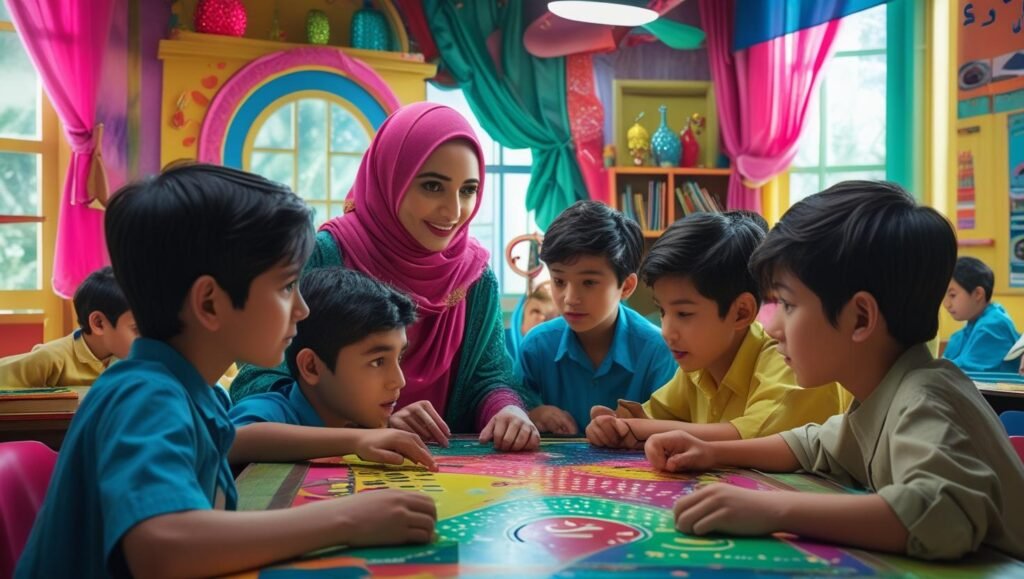
Parents may have limited time, or may be concerned about conveying creed in an educationally sound way. Noor Elbayan Academy teaches Aqidah, Fiqh and Seerah to children alongside the Quran and Arabic. Its certified Azhari teachers, who have more than ten years of experience and include holders of an Ijazah with a connected Sanad, give live one-to-one lessons of 30 minutes over Zoom or Google Meet, in English, French or Arabic. Girls are taught by female teachers, and a report is sent to the parents after every lesson.
The lessons follow the same gradual, question-led spirit as the book. When a child is taught the divine name Ar-Raqib, the Watchful, the teacher does not stop at the word and its meaning. The teacher tells the well-known story of the young shepherd who was asked to sell a sheep in secret and answered, “Then where is Allah?”, and then asks what the child would do on finding money at school when nobody is watching. Discussion of this kind turns knowledge into something the child lives.
The Noor Al-Bayan method supports this work. A child who reads Arabic correctly with its vowel marks finds it easier to read the stories of the Prophets, memorize Hadith and understand rulings. Parents can review the content of the programme dedicated to this book before enrolling.
Points to check before choosing a programme
- The child’s level: whether the child is a complete beginner, can read, or has memorized some Surahs.
- The curriculum: which texts are used and how the programme moves from one topic to the next.
- Delivery: whether lessons are live, how long they last and how many are given each week.
- Suitability: whether the style of explanation matches the child’s age.
- The parent’s role: whether regular reports show what has been studied, so that it can be reviewed at home.
Frequently asked questions
What is the right age to begin studying the book?
Lessons can begin from age 6, through oral repetition of the questions and answers. From about seven, the age of discernment, structured study of the book becomes important for establishing the concepts firmly.
Is the book only for children?
No. Although the title addresses children, the content suits young people, adults reviewing the essentials and new Muslims, because it contains what every accountable Muslim needs to know.
How should a parent respond to a difficult question about Allah?
The child should never be rebuked for asking. The answer should be simple, truthful and based on the texts. If the child asks what Allah looks like, the parent explains that Allah is greater than anything we see, that ﴿ليس كمثله شيء﴾ (“There is nothing like unto Him”), and that the believers will see Him in Paradise, if Allah wills. A parent who does not know an answer should say so honestly, praise the question and look for the answer with the child or ask the teacher.
Does this book replace memorization of the Holy Quran?
Neither replaces the other. The Quran is the foundation, and this book explains the creed and rulings of the religion. Combining the two, for example through online Quran memorization courses, produces a balanced Muslim child.
Does the book replace a specialist teacher?
The book is an excellent family reference, and school provides general basics. A specialist teacher, however, can assess the child’s understanding, gently correct misconceptions and motivate continuously. Reading at home combined with guidance from an experienced teacher is the most effective approach.
Can a child who does not speak Arabic follow this curriculum?
Yes. Creed is not tied to one language. The concepts can be explained in English or French while the Arabic wording of verses and Adhkar is learned gradually. Some programmes assume a foundation in reading, so the requirements should be checked before enrolling.
What can be done when a child becomes bored with religious lessons?
The approach should be changed, not the goal. Shorter sessions, questions in place of lecturing, stories of the Prophets and both material and moral rewards usually restore the child’s interest.
How can a copy of the book be obtained?
A PDF copy is available from trusted Islamic websites, and the printed edition is sold in bookshops. The printed edition is preferable because it reduces the time children spend in front of screens.
Conclusion
Building the mind and heart of a child is the greatest investment a parent can make. Every verse memorized, every Hadith understood and every principle of creed established in the heart is an ongoing charity for the parent and a source of security for the child. This task should not be left to chance or to the surrounding environment.
Parents may book a free trial lesson with Noor Elbayan Academy so that a qualified teacher can assess the child’s level and guide the child towards reciting the Quran with correct Tajweed, answering questions of creed with confidence and adopting the manners of Islam.