 Noor Elbayan Academy
Islamic Essentials Course for Children: Aqidah, Fiqh and Seerah

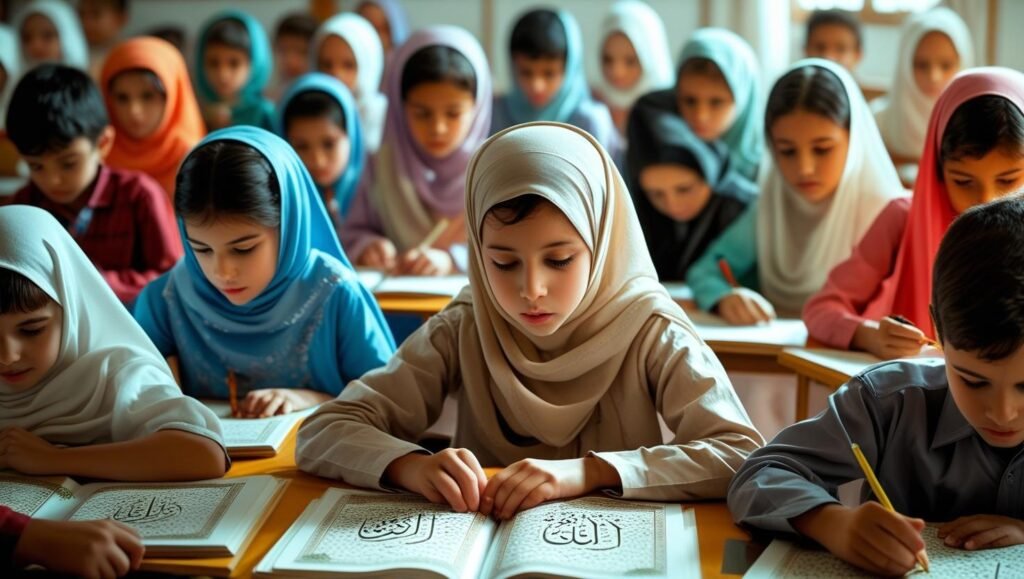
As children grow, so do their questions about the Creator, about prayer, and about right and wrong. Food, clothing and a strong academic education are not enough on their own to raise a balanced person. Screens compete for children’s attention, and ideas foreign to their faith reach them through games and short videos. A complete ban is rarely practical; the stronger alternative is a learning environment that is both engaging and trustworthy.
Allah says in the Quran: “يَا أَيُّهَا الَّذِينَ آمَنُوا قُوا أَنفُسَكُمْ وَأَهْلِيكُمْ نَارًا”, which means: “O you who believe, protect yourselves and your families from a Fire.” Classical scholars described the child as a trust held by the parents, with a pure heart like a precious jewel that is free of any engraving and receptive to whatever is engraved upon it. Noor Elbayan Academy honours that trust through a course on the essentials of Islam for children, built on the book What Muslim Children Must Not Be Ignorant Of and taught by certified Azhari teachers.
The book behind the course
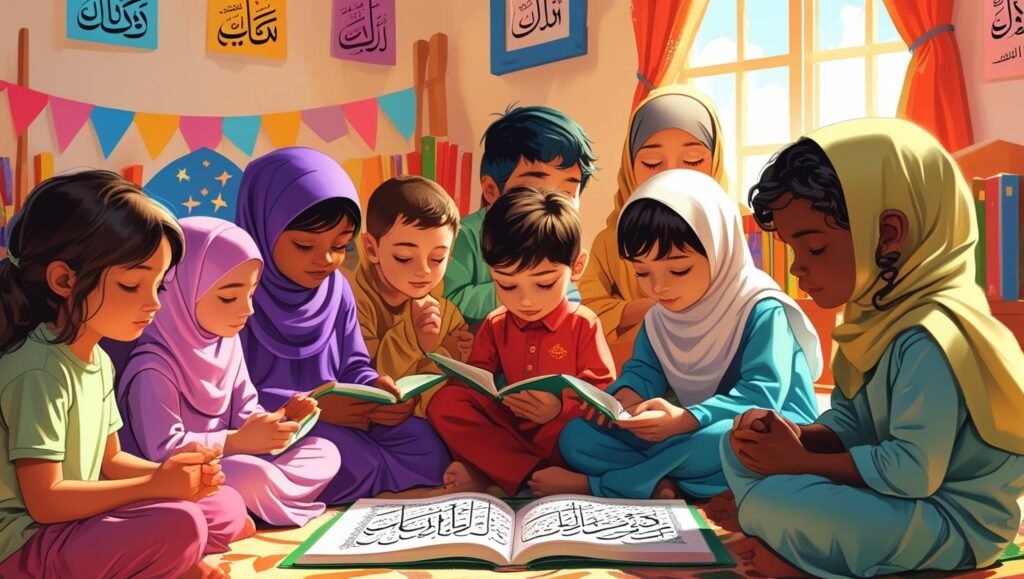
The expression “what a Muslim must not be ignorant of” refers to the minimum religious knowledge that every Muslim is required to learn: the essentials without which faith and worship are not sound. What Muslim Children Must Not Be Ignorant Of applies this idea to children. It is not a large or complicated volume. Its content is practical, written in simple language, arranged according to the intellectual development of children, and suitable for boys and girls alike.
The book is arranged in question-and-answer form. Children naturally ask many questions every day, so presenting the religion as questions and answers matches the way they already think, holds their attention and helps information settle in the memory with little effort. The academy does not present this material as plain text. It has adapted it into a graded course of live lessons, and families who wish to combine it with Hifz may also consult the academy’s article on an interactive book for memorizing the Quran.
Why an early Islamic foundation is a necessity
When a child goes to school or to a sports club, the child meets an open world, not only friends. An eight-year-old may ask with confidence where Allah is, or why Muslims pray and fast. Superficial answers are not sufficient; a young mind needs answers that build sound belief before sincere questions turn into doubts.
Allah created every person upon a pure natural disposition (fitrah), and the task of the course is to preserve it. A child who studies the Book of Allah and the Sunnah of His Messenger in a structured way learns to distinguish truth from falsehood and to decline ideas that contradict the faith with confidence and without embarrassment. When a child grows up knowing the rights of Allah and the rights of parents, the home becomes calmer and daily behaviour changes noticeably. Teaching the principles of the religion is therefore not a summer activity to fill free time; it is knowledge that no Muslim can afford to be without.
What the curriculum contains
Many parents are concerned that a child cannot manage several branches of religious study. A child can do so when the material is presented correctly. The course does not aim to produce a jurist; it presents the essentials, adapted to a child’s level of understanding and taught step by step. The table below summarises the subjects.
| Subject | Content | Benefit for the child |
|---|---|---|
| Aqidah (creed) | The pillars of faith, the Oneness of Allah and His Beautiful Names | Builds certainty and love of Allah, and answers the child’s natural questions |
| Fiqh | Purification, ablution and the correct description of prayer | Trains the child to perform acts of worship correctly from an early age |
| Seerah | Episodes from the life of the Prophet and his conduct with children | Presents the Prophet as a role model and teaches courage and mercy |
| Tafsir and Hadith | Explanation of the short Surahs and memorization of short, comprehensive hadiths | Connects the child’s daily life to the Quran and the Sunnah |
| Manners and character | Kindness to parents, truthfulness, trustworthiness and daily etiquette | Refines behaviour and builds a polite, well-liked personality |
1. Sound creed (Aqidah)
The course begins at the roots, because creed drives every action. Teaching starts with short answers to the great questions in a child’s mind:
- Who is your Lord? My Lord is Allah, who created me and provides for me.
- Where is Allah? Above the heavens, risen over the Throne.
- Who is your Prophet? Muhammad, peace and blessings be upon him.
- What is your religion? My religion is Islam.
The teacher does not dictate complex terminology. The child is connected to the Names and Attributes of Allah through reflection on the stars, the trees and the human being, and learns that Allah watches over him or her with love. This strengthens the inner conscience and protects against deviant beliefs.
2. Worship and simplified Fiqh
Theoretical knowledge has little value without practice. The child learns purification, the correct way to perform ablution, and the pillars of prayer and what invalidates it. The child performs ablution and prayer in front of the camera, and the teacher corrects gently. Prayer is presented as a daily appointment to speak with Allah, so that worship becomes a welcome part of the routine and not a burden.
3. The Seerah as inspiring stories
Children love stories and heroes. Through the Seerah, the child follows the Prophet Muhammad (peace and blessings be upon him) in his lineage, his childhood, his youth and his dealings with his Companions. Children hear how he joked with the young and how he let al-Hasan and al-Husayn (may Allah be pleased with them) ride on his back while he was in prostration. They come to know him as a caring father, a courageous leader and a patient teacher, and this love is the true motive for following him.
4. Tafsir and Hadith
The short Surahs that children usually memorize, such as al-Fatihah, al-Ikhlas, al-Falaq and an-Nas, are explained so that prayer is no longer a set of routine movements. When a child reads (قُلْ هُوَ اللَّهُ أَحَدٌ), “Say: He is Allah, the One”, the teacher explains that Allah is One and has no partner. The child also memorizes short hadiths with clear behavioural meanings. One example is “يا غلام سمّ الله، وكل بيمينك، وكل مما يليك”, meaning “Young man, mention the name of Allah, eat with your right hand, and eat from what is nearest to you”, which the child is asked to apply at the next meal.
5. Islamic manners and character
Manners are the visible fruit of everything above. The child learns the etiquette of eating, sleeping, seeking permission and entering and leaving the home, together with kindness to parents, truthfulness, trustworthiness and avoiding the bullying of others.

A learning path that grows with the child
Teaching children their religion is a long journey, not a quick course. The subjects are distributed across the stages of a child’s development as follows.
| Age | Main focus | Practical examples |
|---|---|---|
| 6 to 8 years | Learning by listening, love of Allah, stories and practical application | Al-Fatihah and al-Ikhlas, the statement of Tawhid, the etiquette of eating and sleeping, the steps of ablution and prayer, illustrated stories of the prophets, the basics of creed through questions and answers |
| 9 to 12 years | Understanding, awareness and commitment | The pillars of faith and of Islam, memorizing parts of the Quran with a general grasp of their meanings, events from the Seerah, basic Fiqh rulings such as purification |
The programme itself is divided into three graded levels, each building on the one before it:
- Foundation level: instils love of and attachment to Allah and His Messenger.
- Intermediate level: introduces the acts of worship in detail and the basic rules of Tajweed.
- Advanced level: deepens understanding and connects the child to the Book of Allah through memorization and reflection.
How the lessons are taught
A young child can understand matters of Aqidah and Fiqh when they are presented in the right way. In a lesson on creed, the teacher does not simply state that Allah is the Creator. The teacher leads a short dialogue:
- Teacher: “Who created the beautiful bird you can see at the window?”
- Child: “Allah.”
- Teacher: “Well done. And why did Allah create us? Only to eat and play?”
- Child: “No, to worship Him.”
- Teacher: “Excellent. The evidence from the Quran is (وما خلقت الجن والإنس إلا ليعبدون): I did not create jinn and mankind except to worship Me.”
When the child gives the answer, the sense of achievement creates an emotional connection with the knowledge. The same care is applied when attention fades. If a young child loses focus during a lesson on ablution, the teacher does not reprimand; the teacher describes ablution as a shield that the child puts on step by step and invites the child to demonstrate it. The academy’s teachers rely on four practices in particular:
- Visual stories: interactive visual aids are used to explain topics from the Seerah, in the same spirit as the mind maps that support Quran memorization.
- Spaced repetition: earlier questions are reviewed at the start of each lesson so that the creed is firmly established.
- Continuous encouragement: correct answers are met with praise that strengthens the child’s confidence. Teaching relies on love, not on fear.
- Regular reports: parents receive a report after every lesson and are guided on how to apply these values at home.
Practical examples from the lessons
Bullying (manners and character)
The teacher does not simply state that bullying is forbidden. The teacher tells how the Prophet (peace and blessings be upon him) defended Bilal and Abdullah ibn Masud (may Allah be pleased with them). The child learns how to stand up for himself or herself politely and how to avoid hurting the feelings of friends. This is linked to the hadith: “The Muslim is the one from whose tongue and hand the Muslims are safe.”
Fear of the dark or of examinations (creed)
The child’s heart is connected to Allah, the Preserver (al-Hafiz) and the Trustee (al-Wakil). The child learns the supplication for leaving the home and the morning and evening remembrances, and understands that Allah is more powerful than everything. This brings reassurance in facing childhood fears.
Who benefits from the course
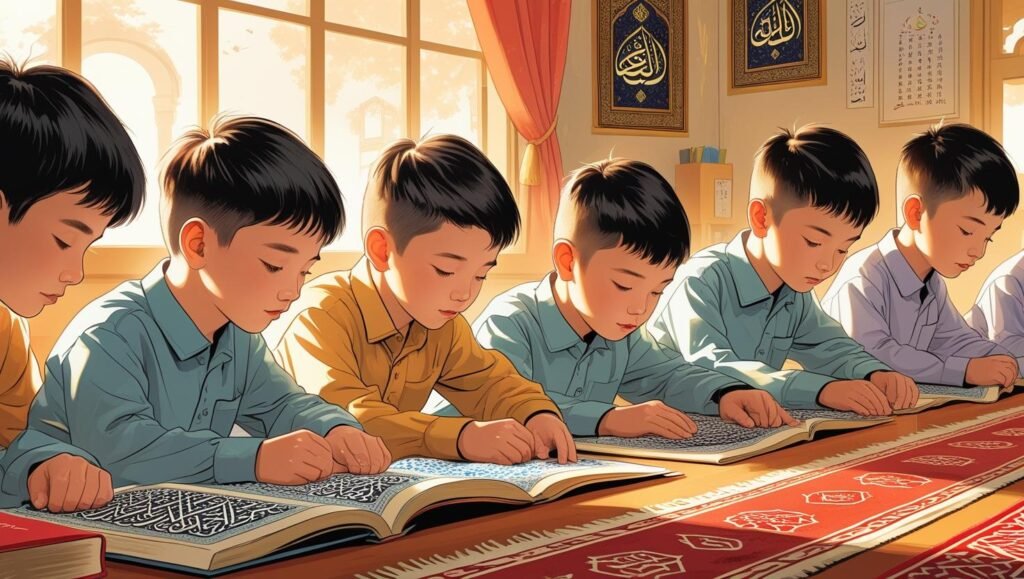
- Young children: the material is presented through colours, nasheeds and illustrated stories, in lessons that suit a short attention span.
- Older children and teenagers: teaching relies on dialogue and reasoning, and students are free to ask and discuss so that any doubt can be addressed.
- Children living in non-Muslim societies: the course keeps them connected to their Islamic roots and reinforces their identity.
- Adult beginners and new Muslims: the fundamentals are presented without detailed juristic disagreements.
Advantages of learning with Noor Elbayan Academy
| Aspect | Crowded traditional classes | Noor Elbayan Academy |
|---|---|---|
| Focus and attention | The child is distracted among dozens of students | One-to-one lessons of 30 minutes with full attention on the child |
| Teaching style | One-way instruction and rote memorization of difficult words | Dialogue, simple explanation linked to the child’s experience, and practical application |
| Flexibility and time | Time lost in travel and waiting | Learning from home over Zoom or Google Meet at a time the family chooses |
| Parent follow-up | Difficult to reach the teacher regularly | A report sent to parents after every lesson |
| Teachers | May lack training in teaching children | Azhari teachers with more than ten years of experience who hold Ijazah, with separate classes and female teachers for girls |
The teacher at the academy is an educator and a good example for the student, attentive to detail, from the pronunciation of the letter Dad to the way the student sits while reciting the Quran. Families who also wish to begin Hifz may read the academy’s guidance on an easy way to memorize the Quran.
Recommendations for parents at home
Education is not the teacher’s task alone, and parents are partners in it.
- Set a silent example. A child who sees a parent put the telephone down at the call to prayer and go to perform ablution has learned the most important lesson in Fiqh.
- Set aside ten minutes a day. Two questions from the curriculum before bedtime, or a short story from the Seerah on the drive to school, are sufficient.
- Connect the lessons to daily life. After a question about thanking Allah, ask the child to name three blessings visible in the room.
- Proceed gradually and gently. A little done regularly is better than much that is interrupted.
- Celebrate religious achievements. Mark consistency in Fajr prayer or a completed Juz just as high marks at school are marked.
Frequently asked questions
What is the right age to begin the course?
The course is suitable from age 6, beginning with very simple questions of creed such as “Who is your Lord?”. The difficulty increases gradually, and the levels continue to suit all ages up to fifteen and above.
Is the course suitable for children who do not speak Arabic?
Yes. Lessons at Noor Elbayan Academy are available in English, French and Arabic, and the curriculum uses short and direct wording, so teachers explain each concept in the language the child understands best.
Is it necessary to obtain the book or a PDF before starting?
No. The teacher provides the material during the lessons. Books are an excellent aid, but a teacher explains unclear meanings, corrects errors and ensures that ideas are understood correctly without excess or neglect.
Does this course replace memorizing the Quran?
No. It complements it. The course prepares the child to understand the creed and rulings found in what is recited, and the academy recommends combining Hifz with Islamic foundation studies.
How long is a lesson and how is the child assessed?
Each lesson lasts 30 minutes, which stays within a child’s attention span. Assessment takes place through continuous revision, oral questions and practical application, such as performing ablution and prayer.
How is boredom avoided in online lessons?
The child is not lectured. The lesson is run as a question-and-answer activity supported by visuals and stories, and because it is one-to-one, the teacher’s attention remains on the child throughout.
Are the teachers prepared for children’s difficult questions about belief?
The teachers are certified Azhari teachers who hold Ijazah. They welcome children’s natural curiosity and answer deep questions about Allah and the universe in a way that is sound in creed, calm and reassuring.
What should parents do if a child refuses to attend lessons?
Harsh compulsion should be avoided entirely. Positive encouragement and engaging stories are more effective, and a change of teacher may help where there is no rapport.
Begin with a free trial lesson
The real fruit of this learning appears in moments such as a young child waking the parents for Fajr prayer, or raising his or her hands in supplication for them after learning that “the pleasure of the Lord lies in the pleasure of the parent”. A child’s religious foundation should not be left to chance or to unsupervised online content. Noor Elbayan Academy offers a free trial lesson in which the parent and child meet one of its teachers, and plans start from $40 per month.
Book a free trial lesson for your child