 Noor Elbayan Academy
The Noor Al-Bayan Method for Children’s Reading and Tajweed

The Noor Al-Bayan method is a teaching programme designed to show children how to read the Holy Quran correctly and apply the rules of Tajweed. It builds on the rules of the Arabic language and on the traditional way of teaching letters and vowel marks, and it presents each skill in a form suited to the child’s age and level. The method serves children from Arabic-speaking homes and children from other backgrounds alike.

Laying the foundation for correct reading
Correct reading is the first pillar of the method. Before any advanced rule is introduced, the child learns to recognise the letters, pronounce each one from its proper point of articulation and join letters into words.
How the foundation is built
- Teaching the letters: lessons begin with the Arabic alphabet, with attention to the articulation point and characteristics of each letter. Interactive exercises, such as recognising and assembling letters, keep the child engaged.
- Basic Tajweed from the start: the child first learns to pronounce each letter correctly, and only then moves gradually towards more advanced rules.
- Practical exercises: words and verses are repeated regularly so that sound pronunciation becomes a habit.
- Listening and imitation: the child listens to accurate recitation and imitates it. Audio aids such as a reading pen can provide a reliable model at home.
- Active participation: the child reads aloud and takes turns reading with the teacher, which builds confidence.
- Assessment and follow-up: reading level is assessed regularly so that the teacher can identify strengths and weaknesses and give the right support.
Why the foundation matters
- A solid base: sound reading makes later learning of Tajweed and comprehension much easier.
- Fewer mistakes: the child learns to avoid common reading errors early.
- Greater confidence: a child who reads correctly is more willing to take part in Quran learning.
Families who wish to choose a suitable programme for their children can contact Noor Elbayan Academy for guidance.
Applying the rules of Tajweed
Tajweed is the discipline of reciting the Quran accurately. The method introduces its rules in a simplified, step-by-step way so that children can apply them while reading.
How Tajweed is taught
- Simple explanation of the main rules: the types of Madd (natural, temporary and compulsory lengthening), Idgham and Izhar (merging letters and pronouncing them clearly), and Ghunnah (nasalisation). Visual and audio teaching make each rule clearer.
- Gradual progression: basic rules come first and more complex rules follow once the basics are secure.
- Practical application: the child reads short passages while concentrating on the rule being studied.
- Repetition and revision: rules already learned are revisited continually, and a revision chart can be used to track mastery of each one.
- Guidance and supervision: the teacher corrects mistakes directly during reading and gives regular feedback on points that need improvement.
- Learning from models: listening to skilled reciters shows the child how the rules sound in practice.
Benefits of applying Tajweed
- Better reading: the child recites the Quran correctly and with fewer errors.
- Deeper understanding: awareness of the rules makes the child more attentive to the meaning of the verses.
- A trained ear: the child develops a sense of hearing and an appreciation of the beauty of recitation.
Learning through play
Play is a natural way for children to engage with the world. Combining teaching with play holds their attention and makes Quran learning enjoyable. Distance learning suits this approach well, as explained in the academy’s article on distance learning and Quran memorization.
- Interactive educational games: flashcards, puzzles and electronic games that practise letter recognition, pronunciation and Tajweed rules.
- Stories and role play: Quranic stories told with accompanying activities help children understand and remember the meaning of the verses.
- Rewards: small incentives for good memorization and reading encourage children to keep improving.
- Technology and media: educational applications with animation and interactive activities allow practice at any time and place.
- Creativity: children can express what they have learned through drawing or by designing their own flashcards.
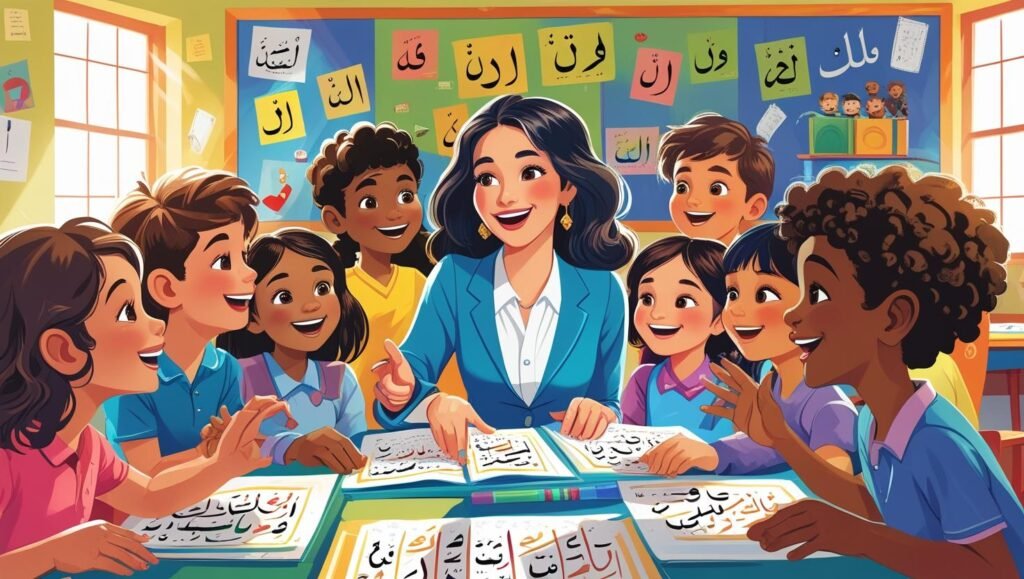
Learning through play increases motivation and improves comprehension, because information met in an enjoyable setting is absorbed more readily.
Revision and repetition
Revision and repetition fix what has been learned in the child’s memory and strengthen reading skills.
- A revision schedule: fixed times for revision help the child organise the week, and earlier lessons are revisited periodically.
- Varied methods: individual reading, repeating after the teacher and educational games keep revision from becoming monotonous.
- Repeating verses: verses are repeated several times until they are firmly memorized, which also improves pronunciation and confidence.
- Listening to recitation: the child listens to skilled reciters and repeats what is heard.
- Assessing performance: periodic oral or written assessments show how far the child has progressed in memorization and Tajweed.
- Sharing at home: children are encouraged to recite what they have learned to their family, which builds confidence and reinforces memory.
Regular revision moves information into long-term memory, steadily improves performance in reading and Tajweed, and gives children confidence in their ability to recite correctly.
Guidance and mentoring
Teacher guidance is central to the method. It gives each child the support needed to develop reading and Tajweed skills.
- Individual support: the teacher supports each child according to need and level of progress, and gives extra help where it is required, whether in memorization or in applying Tajweed.
- Feedback: immediate feedback after each session highlights what went well and what needs work. Positive feedback motivates children and strengthens their confidence.
- Learning strategies: children are taught effective ways to memorize and revise, such as memory techniques, mental association and dividing verses into smaller parts.
- Involving parents: parents are kept informed of their child’s progress and advised on how to support learning at home.
- Setting goals: short-term and long-term goals, such as memorizing a set number of verses within a set period, give children a sense of purpose.
- Communication skills: children are encouraged to express their thoughts and ask questions, which builds a strong relationship between teacher and student.
A flexible learning environment
The method adapts to different learning styles and circumstances. Its wider advantages are described in the article on the benefits of the Noor Al-Bayan method.
- Distance learning: children can learn online wherever they live, at times that suit the family.
- A personalised curriculum: lesson content and activities are adjusted to each child’s level of understanding and capacity to memorize.
- Varied teaching styles: visual, auditory and practical teaching are combined so that every child can learn in the way that suits them best.
- Use of technology: educational applications, videos and interactive games enrich the learning experience.
- Interaction: children are encouraged to ask questions and discuss what they are learning with their teacher.
- Balance: study is balanced with recreation, which supports the child’s mental and physical wellbeing.

This flexibility raises motivation, improves comprehension and encourages children to become more independent in managing their learning.
The impact of the Noor Al-Bayan method
- A stronger relationship with the Quran: children learn to recite it and understand its meanings, and feel closer to it.
- Improved reading and Tajweed: recitation becomes more accurate, and the language skills gained help in Arabic and writing.
- Self-confidence: memorizing verses and applying the rules gives children a sense of achievement.
- Moral values: Quran-based education nurtures good conduct, patience and perseverance.
- Continuous learning: children are encouraged to revise, develop their skills and explore further knowledge.
- Family and community: families become more involved in their children’s education, and children carry Islamic values into their surroundings.
Conclusion
The effect of the Noor Al-Bayan method extends beyond academic instruction to the development of the child’s character. By focusing on correct reading and the rules of Tajweed, it helps raise children who are capable readers and who love the Holy Quran.
Noor Elbayan Academy teaches the method through live one-to-one lessons of 30 minutes with certified Azhari teachers, and offers a free trial lesson. More detail is available in the article on learning the Noor Al-Bayan course at the academy, and parents can register through the contact page.