 Noor Elbayan Academy
Quran Memorization for Children: A Practical Guide for Parents
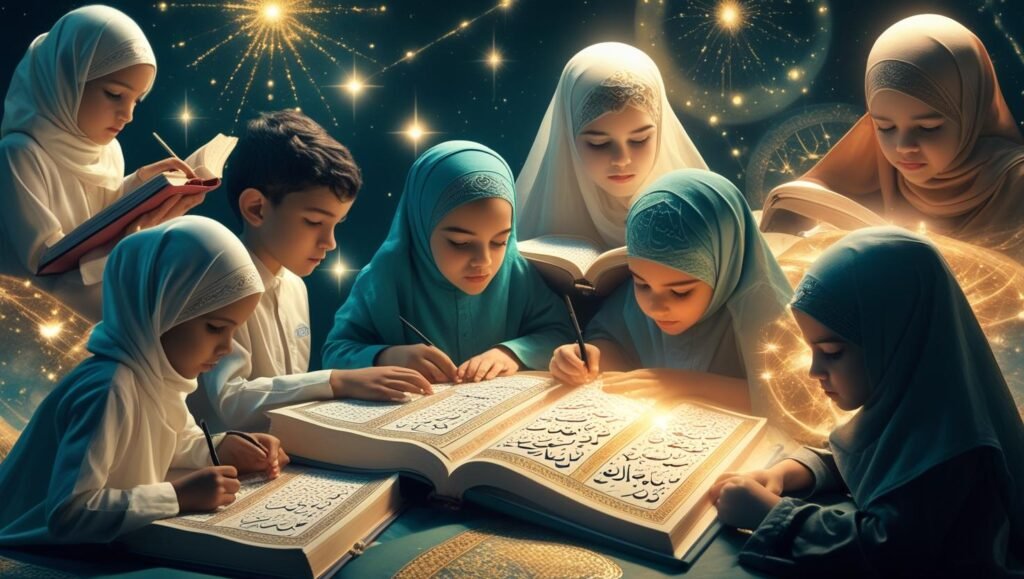
Quran memorization for children is a priority for many Muslim families. It is more than learning letters and words: it is an educational and spiritual process that raises children to love the Book of Allah and to live by its teachings. This guide explains why Hifz matters in childhood, which methods work well, what the family and the teacher each contribute, how to overcome common difficulties, and how online lessons at Noor Elbayan Academy support the process.
What Quran memorization for children involves
Hifz for children combines learning to recite the Quran aloud correctly with committing it to memory. It usually progresses in two stages:
- Learning the rules: the child learns the reading and Tajweed rules needed to recite the Quran correctly.
- Memorizing the Surahs: the child memorizes Surahs gradually, according to ability and progress in the lessons.
Childhood is a stage in which knowledge is acquired with ease, which is why starting early is so valuable. The process requires patience and consistency, so it should remain enjoyable and motivating for the child.
Why Quran memorization matters for children
Instilling Islamic values and character
Memorizing the Quran establishes noble values in children from an early age. Through the verses they learn mercy, honesty, justice, sincerity and tolerance, and these values become part of their character.
Building a strong bond with the faith
Memorizing verses and understanding their meanings gives the child a sense of belonging to the religion. The Quran becomes a source of guidance in daily life, which strengthens the child’s faith and relationship with Allah.
Strengthening memory and concentration
Hifz depends on repetition and learning by heart, which develops memory. Attention to correct pronunciation and Tajweed rules improves concentration and attentive listening, and these skills benefit the child in school and elsewhere.
Further benefits
- It builds discipline, because memorization requires daily commitment and effort.
- It builds self-confidence: a child who recites with assurance feels pride in the achievement and is encouraged to pursue other goals.
- It helps preserve classical Arabic, the language of the Quran, and improves the child’s language and comprehension skills.
- It connects generations within the family through a shared practice.
Effective methods for teaching children the Quran
Repetition and oral instruction
Repetition is the oldest and simplest method. The verse or Surah is recited to the child several times until it is memorized. Listening and repeating after the teacher introduces correct pronunciation and Tajweed, and it is particularly suitable for young children. Recitation should be accurate and slow so that the words are learned correctly.
Group recitation
Reciting with peers creates an encouraging environment. Children feel positive competition and enthusiasm, and they develop social skills alongside their recitation and memorization.
Modern technology
Educational applications with repeated audio recitations, interactive games and online educational channels can support memorization and hold the attention of children.
Regular revision
Frequent revision of what has been memorized keeps it firm and allows steady progress.
The role of the family
Continuous encouragement and support
The family plays a central role by encouraging the child and showing pride in each achievement. Words of praise strengthen confidence, and small symbolic rewards for completing a set portion encourage the child to continue.
A fixed daily time for recitation
A fixed daily schedule makes memorization part of the routine. It is best to choose a time when the child concentrates well, such as the early morning, after a prayer, or before sleep.
A motivating learning environment
A quiet, suitable place helps the child to focus. This may be a corner of the home decorated with Quranic calligraphy, with calm recitation playing in the background. When all family members take part in recitation, the child becomes more engaged.
Choosing the right teacher
Qualities of a good Quran teacher for children
- Ability to work with children: the teacher should be patient and friendly, and should understand the emotional and intellectual needs of the child.
- Good communication: effective communication attracts the child and encourages continued memorization.
- A good example: a teacher who adheres to the teachings of Islam has a positive influence on the child.
- Flexibility and understanding: the teacher adapts the method to the pace and individual needs of each child.
The effect of teaching style
The teaching style has a strong effect on how well the child understands and memorizes. Engaging methods based on dialogue and interaction are more effective than instruction by rote alone. A teacher may use educational games, Quranic stories and multimedia to convey meanings simply and to strengthen memory.
Teaching Tajweed
Tajweed is an essential part of Hifz and not an optional addition. The teacher shows the child how to pronounce each letter correctly and how to apply rules such as lengthening (madd), shortening (qasr) and nasalization (ghunnah). This makes recitation more accurate and more beautiful, and increases the child’s enjoyment of it.
Supporting activities
Quran competitions
Competitions at school or within the family, with prizes based on progress, are an effective source of motivation. They can cover correct recitation with Tajweed as well as memorization.
Quranic stories
Stories help children understand the meanings of the Quran in a simple way. Through them children learn about the Prophets and the lessons of their lives, which awakens curiosity and reinforces values such as patience, courage and faith in Allah.
Islamic educational games
Interactive games in applications, and hands-on activities such as Quranic puzzles or alphabet cards linked to verses, make memorization more enjoyable and support understanding.

Long-term benefits of Quran memorization
Stronger memory and mental abilities
Continuous practice in memorizing strengthens long-term memory and makes it easier to recall information, which helps the child in academic life.
A sound Islamic character
By learning the verses, the child absorbs values such as honesty, trustworthiness, mercy and justice, and becomes able to make sound decisions in daily life according to Islamic principles.
A lasting positive effect
A child who memorizes the Quran tends to respect time, value knowledge and aspire to succeed. Hifz also provides a spiritual foundation that remains for life and gives the child the inner strength to face challenges and outside pressures with confidence.
Common challenges and how to overcome them
Boredom and difficulty in memorizing
- Vary the method: group recitation, stories, or questions and answers help to maintain interest.
- Divide long portions: splitting a Surah into small parts lets the child feel progress after each one.
- Use rewards: simple gifts or favourite activities after completing a portion or improving performance are effective incentives.
Balancing school and memorization
- Set a flexible schedule: reserve a specific daily time for Hifz that does not affect study time, such as the first hour of the morning or the afternoon.
- Balance activities: some days may be devoted to the Quran and others to school revision.
- Involve the family: when family members support the allotted time, the child organizes time more easily.
Keeping the child motivated
- Encourage consistently: positive phrases reassure the child that progress is being made.
- Celebrate progress: marking small achievements, such as finishing part of a Surah or a revision, builds confidence.
- Provide a role model: a relative who has completed the Quran can inspire the child to continue.
Parents should remain patient and understanding throughout. Positivity and encouragement are the keys to a child’s continued progress.
Online Quran memorization for children
Advantages of online lessons
Online Hifz offers a flexible experience in which children learn and memorize from home and meet their teacher at a time that suits the family. This makes it easier to balance school and memorization. Live, interactive sessions make lessons more enjoyable, and regular reports from the teacher allow parents to follow progress, which increases the child’s commitment.
The role of online teachers
The success of a child in online Hifz depends greatly on the experience of the teacher and the ability to use modern teaching methods with children of different ages. Teachers focus on correct pronunciation and Tajweed, use repetition to ensure mastery, and nurture love of the Quran through encouragement and rewards.
How to choose a suitable online programme
- The teaching system should match the abilities of the child.
- The learning environment should be motivating and based on interaction between teacher and child.
- Schedules should be flexible enough to support regular attendance.
- Periodic assessments should measure progress and identify points that need improvement.
Why starting early matters
Young children have a great capacity for memorization and quick learning, and early online Hifz makes use of it. It instils values such as patience and commitment from a young age, and it improves the child’s Arabic and pronunciation of letters and words.
How Noor Elbayan Academy supports children
Noor Elbayan Academy offers Quran memorization programmes for children through live one-to-one lessons of 30 minutes over Zoom or Google Meet. Lessons are taught by certified Azhari teachers with more than ten years of experience and are available in English, French and Arabic. Classes for boys and girls are separate, with female teachers for girls. Parents receive a report after every lesson, and a free trial lesson is available. Families with questions about Quran memorization for their children are welcome to contact the academy for guidance.
Conclusion
Quran memorization for children is a long-term investment in their religious and personal future. It requires patience, effort and dedication from parents and teachers, and its results justify that effort. With a suitable programme, a supportive home and a qualified teacher, children can memorize the Book of Allah steadily and grow up attached to its values.