 Noor Elbayan Academy
Teaching Children the Quran Online: A Practical Guide
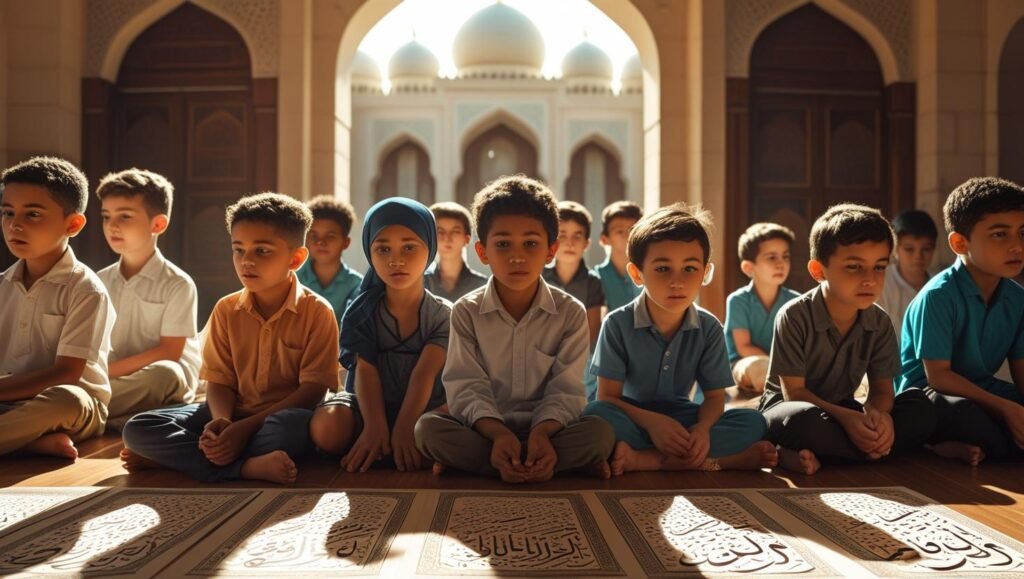
Teaching children the Quran online can be highly effective when it is approached with a clear method. This guide sets out the steps that matter most: choosing a suitable platform, using interactive tools, combining live lessons with revision, motivating the child, organising study time, and giving steady support at home.
Choosing a suitable learning platform
The choice of platform is the foundation of effective and enjoyable learning. Parents should weigh the following points.
- Educational content: the platform should offer recitation, simplified Tajweed, memorization, and the meanings of the verses, in lessons that are clearly divided by age group.
- Qualified teachers: teachers should be qualified in teaching the Quran, specialised in recitation and Tajweed, and experienced in working with young children.
- Engaging lessons: visual aids, short videos, educational games and interactive quizzes help children enjoy learning and remain attentive.
- Live lessons: a live class allows the teacher to correct recitation in real time. Some platforms also provide material that children can return to for revision.
- Progress tracking: regular reports should show how the child is advancing in Hifz, recitation and Tajweed, so that parents can follow improvement continuously.
- Ease of use: the lesson environment should be simple for a child and compatible with the phone, tablet or computer the family uses.
- Support: responsive technical and customer support resolves problems quickly for children and parents.
- Reviews and recommendations: the experience of other parents, and the advice of trusted people who have used the platform, give a clear picture of its quality.
- Cost and trial: the cost should be reasonable, with plans to suit different budgets. A trial lesson allows parents to test the teaching before committing to a paid plan.
Parents who wish to ask about lessons for their child can contact Noor Elbayan Academy here.
Using interactive learning tools
Children respond best to activities that combine learning with enjoyment. The following tools are widely used in online Quran teaching and can also be used by parents at home.
- Animated Quranic stories: stories presented visually make the meanings of the verses easier to understand and to remember.
- Educational games: letter and word recognition games and memory games, with rising levels of difficulty, encourage children to progress.
- Nasheeds and rhythmic repetition: simple melodies and rhythm engage the auditory memory and make repetition pleasant.
- Quizzes and activities: a short quiz at the end of a lesson, filling in missing words, or putting verses in order lets children apply what they have learned immediately.
- Audio and repetition: the child listens to a clear recitation and repeats each verse after the teacher. Recordings that pause after each verse are particularly helpful.
- Interactive videos: short clips that explain a verse or a Tajweed rule, and that put questions to the viewer, hold the attention of the child.
- Augmented reality: some applications present Quranic stories in three-dimensional scenes that children can explore.
- Interactive whiteboards: dragging and arranging letters, words and verses on a virtual board teaches recognition and order in a practical way.
- Prizes and certificates of appreciation: a small prize or a certificate from the family encourages the child to continue.
Interactive tools bring three benefits: they motivate children, they develop listening skills because children apply what they hear at once, and they lengthen the time a child can concentrate.
Learning through videos and live lessons
Recorded videos and live lessons serve different purposes, and the two complement each other.
Recorded educational videos
Recorded videos are available at any time and are usually divided into small units. A child can watch a lesson again until the recitation, the verses or the Tajweed rule has been mastered, pausing to read a verse aloud or repeat it. Many suitable videos are available online for families to use between lessons.
Live lessons
In a live lesson the child interacts directly with the teacher, asks questions, and receives answers immediately. The teacher hears the recitation and corrects mistakes on the spot, which improves pronunciation and the application of Tajweed. The teacher can also adapt the lesson to the child and concentrate on the points that need improvement.
Group and one-to-one lessons
In a group lesson a child learns alongside others, which brings a sense of participation. In a one-to-one lesson the child has the full attention of the teacher, and the content is adjusted to the level and needs of that child. Noor Elbayan Academy teaches through live one-to-one lessons of 30 minutes over Zoom or Google Meet.
Combining the two
- Keep live lessons at fixed times each week, which teaches discipline and commitment.
- Use a short video before a lesson as preparation, so that the teacher can concentrate on detail and questions.
- Set a time between lessons to review what was taught.
- Add clear audio recitation to help the child improve the articulation points of the letters.
- Expect the teacher to use praise during the lesson. It builds confidence and encourages the child to take an active part.
Motivating children with rewards and encouragement
Children work harder when they feel that their effort is valued. The following methods help them persevere.
- Material and symbolic rewards: a small gift after a new Surah, or gold stars and certificates of appreciation that can be collected towards a larger reward.
- Verbal encouragement: praise the child directly for a correct recitation or a newly memorized verse, with specific remarks such as “Your recitation is improving very well”. Praise in front of the family adds a sense of pride.
- A points or star system: award a star for each completed task, and display the achievements on a chart in the room of the child.
- Non-material rewards: special time with parents, a short outing, a favourite activity, or a household privilege such as extra play time.
- Digital rewards: some educational applications unlock characters or items when tasks are completed.
- Friendly challenges: a memorization or recitation challenge among siblings or friends, with simple prizes such as illustrated books, adds enjoyment.
- Linking rewards to faith: children should understand that learning the Quran is a path to reward from Allah. Parents may mention the hadiths on the virtue of learning and memorizing the Quran.
- Variety and surprise: alternate between kinds of reward, and offer one unexpectedly from time to time, so that the child does not come to expect a reward for every step.
- Religious occasions: a visit to the mosque or attendance at a religious gathering can itself be a reward that strengthens attachment to the Quran.
- Independence: as the child advances, encourage responsibility for learning without constant external reward.

Organising study time
Children need an orderly routine that balances learning with rest and other activities.
- A fixed daily time: a set time for memorization, revision or Tajweed builds good habits. Where the same hour is not possible every day, keep the time flexible but do not let a day pass without learning.
- Short sessions: sessions of 20 to 30 minutes are best, since children lose concentration in long sittings. A break of 5 to 10 minutes afterwards restores attention.
- One goal per session: a single aim, such as memorizing one verse or improving the pronunciation of another, prevents the child from feeling overwhelmed.
- Varied activities: across the week, include recitation, memorization, revision of the rules and Tajweed.
- Visual schedules: a timetable in the room of the child, with a chart on which each completed task is marked, shows progress clearly.
- Balance: distribute study around play and other activities, and choose the hours when the child is most alert, such as the morning after breakfast or the afternoon.
- Alarms and reminders: digital reminders mark the start and end of each session and the goals of the week.
- Weekly review: the teacher or the parents review progress each week and adjust the schedule, adding sessions where a topic needs more time.
- Time for revision: combine new verses with revision of earlier ones in every session, so that what has been memorized is not forgotten.
- A suitable place: a quiet corner of the home, free of distractions, with the Mushaf and the device ready before the session begins.
- Flexibility: when the child is tired or bored, shorten the session. Family occasions may also require a change to the schedule. The aim is for the child to enjoy learning without strain.
Continuous support from parents
The role of parents is as important as that of teachers. It extends beyond providing resources to motivation, supervision and the nurturing of religious values.
- A good example: children who see their parents read the Quran regularly understand its importance. Parents can also sit in on lessons to create a shared learning atmosphere.
- Active involvement: listen to the recitation of the child after the lesson, comment positively on every improvement, however small, and set a daily or weekly time to revise memorized verses together.
- Commitment to the schedule: remind the child of lesson times and encourage a punctual start.
- Spiritual motivation: speak about the virtue of the Quran, and hold a small family celebration when a Surah is completed.
- Communication with teachers: stay in regular contact with the teacher to learn how the child is progressing, and ask for advice on helping at home with Tajweed or memorization.
- Patience with difficulties: when the child struggles or feels discouraged, respond with understanding and encouragement instead of pressure.
- Independence and time management: gradually let the child take charge of revision and of preparing a personal timetable, while keeping a balance between study and play.
- Quran in family life: reading the Quran together as a family, and encouraging the child to take part in Quran events held at the local mosque or school, deepens attachment to it.
Giving attention to Tajweed and recitation
Tajweed ensures that the Quran is recited correctly, as it was revealed to the Prophet Muhammad, peace and blessings be upon him. Teaching it to children requires a method that is both simple and precise.
- Introduce the rules gradually: begin with basic rules such as Izhar, Ikhfa, Idgham and Iqlab, presented simply and supported by diagrams and audio examples.
- Teach the articulation points and qualities of the letters: start with the letters that are easy to pronounce, then move to those that need more training, such as the throat letters (ʿayn, ḥa, ha and kha). Repetition is the key to mastery.
- Listen to model recitation: recordings of skilled reciters with clear voices help children absorb correct pronunciation, and imitating them improves their own.
- Use interactive resources: applications and illustrated videos that explain the rules in a lively way make Tajweed easier for children.
- Learn with a specialist teacher: direct lessons provide immediate correction. One-to-one sessions allow extra attention to any rule the child finds difficult.
- Practise daily: a daily time for recitation with attention to the rules, and periodic revision of rules learned earlier, make Tajweed a natural part of reading.
- Apply the rules to short Surahs: the Surahs of Juz Amma are easy to memorize and allow the rules to be practised as the child memorizes.
- Recognise progress: a small prize for mastering a rule encourages further effort.
- Explain the spiritual purpose: the child should understand that Tajweed is not simply about a pleasant voice. It is following the Sunnah of the Prophet, peace and blessings be upon him, and correct recitation is part of honouring the Quran.
- Cooperate with the teacher: parents should follow the notes of the teacher and invite the child to recite at home, applying what has been learned.
Learning alongside other children
Contact with peers can strengthen motivation. Families may arrange the following within the home, among relatives and friends, or through the local mosque.
- Recitation circles: children meet regularly and take turns reciting, listening to one another and offering constructive remarks.
- Shared goals: memorizing a particular Surah together builds a sense of responsibility and belonging.
- Peer teaching: older or more advanced children help younger ones, which also deepens their own understanding.
- Friendly contests: memorization contests with token prizes for all participants raise enthusiasm.
- Flashcards and group games: games built around Tajweed rules or recitation make shared learning enjoyable.
- Sharing stories: children discuss the Quranic stories that affected them, which encourages reflection on meaning.
- Family sessions: parents speak about the place of the Quran in their own lives, which raises the value of learning in the eyes of the child.
- A supportive atmosphere: children should be taught to encourage one another, in a setting where they feel safe to take part.

Making use of modern technology
- Educational applications: many applications offer interactive lessons in memorization and Tajweed and let the child learn at an appropriate level and pace.
- Audio and video: recordings of professional reciters and videos that demonstrate the rules of Tajweed in practice.
- Online classes: live lessons with specialist teachers, with flexible scheduling that makes commitment easier.
- Virtual and augmented reality: for example, virtual tours of historical places connected with the Quran.
- Educational games: games centred on Tajweed and Hifz reinforce knowledge indirectly.
- Educational websites: websites with lessons, interactive material and tests on the Quran.
- Digital notes: older children can record notes on Tajweed rules or new verses, or prepare a short presentation on a Quranic topic.
- Self-revision: digital resources allow children to review what they covered in the lesson.
- Assessment: online tests and performance reports help parents and teachers follow progress and address weak points.
Focusing on memorization and listening
Memorization and listening are the two pillars of Quran learning. The following practices strengthen both.
- Set a daily time and a weekly target: a routine helps the child adapt to memorization, and a set number of verses each week gives a sense of achievement.
- Divide the verses: begin with a small portion and increase gradually, repeating memorized verses often to fix them in memory.
- Memorize by imitation: the child listens to a skilled reciter and imitates the recitation, which improves pronunciation.
- Listen regularly: recitation can be played during journeys or daily activities, using an application with a range of reciters.
- Engage with the content: encourage the child to ask about the meaning of what is heard and to note down new ideas.
- Revise continuously: regular revision sessions each week ensure that memorized verses are retained.
- Involve the parents: parents review verses with the child, listen during memorization, and give support when difficulties arise.
- Learn through stories: linking verses to the stories connected with them makes the meaning clearer and the memorization deeper.
Conclusion
Successful online Quran learning for children rests on a good platform, a qualified teacher, engaging methods, an orderly schedule, sound Tajweed, steady revision, and parents who remain involved. Noor Elbayan Academy is committed to helping children memorize the Quran in a clear and engaging way that nurtures a love of reading and learning from an early age. Lessons are taught one-to-one by certified Azhari teachers, a report follows every lesson, and each family may begin with a free trial lesson. To arrange one, parents can contact the academy.